 Skip to content

Orthodox shrines of Tiraspol and Bender
Orthodox Shrines of Tiraspol and Bender
Discover the deep spiritual and historical ties between the Orthodox faith and the Russian Imperial legacy on this captivating one-day tour of the Orthodox shrines of Tiraspol and Bender — a 21 km journey across 7 remarkable sacred sites that together tell the story of faith, war, sacrifice and devotion across three centuries.
Bender: Where Faith and Empire Converge
The journey begins at the magnificent Transfiguration Cathedral (31 Sovetskaya Str., Bender) — the spiritual centerpiece of the city and one of its most beloved architectural landmarks. Standing in the heart of Bender, this cathedral has presided over the city’s joys and sorrows for generations, its gleaming domes a constant presence on the skyline.
After 2.2 km, the route continues to the Church of the Faithful Saint Prince Alexander Nevsky (2 Petra Panina Str., Bender) — a church of exceptional historical significance. Erected in 1833, it holds the distinction of being the only active military temple in all of Pridnestrovie and one of the oldest religious buildings in Bender. Dedicated to Russia’s most celebrated warrior-saint, this church embodies the profound connection between Orthodox faith and military service that defines so much of this region’s identity.
Just 2.4 km further, the imposing Bendery Fortress (2/3 Petra Panina Str., Bender) awaits — not merely a military monument but a deeply symbolic sacred site in its own right. A testament to the Russian Empire’s victory in the Russian-Turkish wars, the fortress served as a mighty stronghold for the Russian army after Bender entered the empire, its walls soaked in centuries of history and sacrifice.
After 2.3 km, the route arrives at the Church of the Image of Jesus Christ Not Made by Hands — the Spas Nerukotvornyi (Zoya Kosmodemyanskaya Str., Bender) — a temple-chapel of profound spiritual significance located on the grounds of the Military Historical Memorial Complex. This sacred space was established on the site of an ancient military cemetery where the remains of countless soldiers of the Russian Imperial Army — fallen in the wars of the 18th, 19th and 20th centuries — were laid to rest.
Just 310 meters away, the Bendery Military Historical Memorial Complex (Yermakova Str., Bender) itself deserves unhurried reflection. Rising from the hallowed ground of that same imperial cemetery, this complex is one of the most moving and historically layered sites in Pridnestrovie — a place where the Orthodox tradition of honoring the fallen finds its fullest and most powerful expression.
Tiraspol: Living Faith in the City of the Russian Forces
After a 10 km drive to Tiraspol, the route continues to the Church of St. Andrew the First-Called (Karl Liebknecht Str., Tiraspol) — a remarkable church built in 1997 on the territory of the military garrison of the Operational Group of Russian Forces in Pridnestrovie. Its location speaks volumes: near this very spot once stood the Trinity Church of the 56th Zhytomyr Infantry Regiment, destroyed in the 1930s — a loss this church quietly honors through its very existence.
The journey concludes 4.9 km further at the Holy Presentation Pachomius Convent (43 Lenin Str., Tiraspol) — a place of deep contemplative beauty set within what was once the Cathedral cemetery of the city. Here, soldiers of the 8th Astrakhan Dragoon Regiment and the 56th Zhitomir Infantry Regiment, as well as parishioners of the Nikolsky Cathedral, were laid to rest. Today, the convent’s peaceful gardens and sacred spaces invite visitors to reflect on the enduring bond between faith, memory and the land — a fitting and profoundly moving conclusion to a day spent in the company of Pridnestrovie’s most sacred Orthodox heritage.
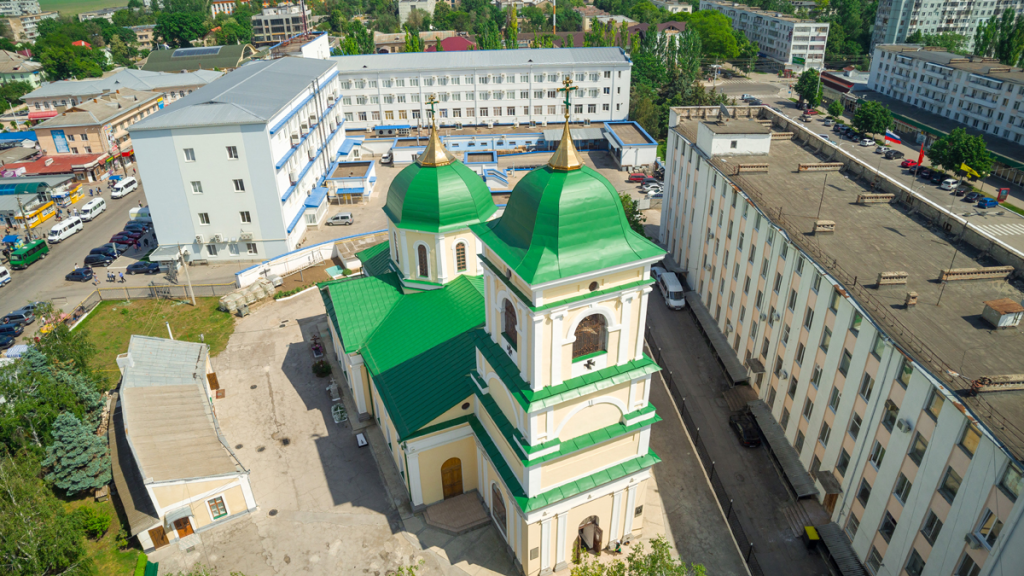
Transfiguration Cathedral, Bendery
A major reconstruction of Bendery began once the city became part of the Russian Empire, with urban planners deciding to rebuild the city at some distance from the original Bendery Fortress. In 1814, authorities decided to relocate the Dormition and Nikolsky churches to this new city center, but their dilapidated condition ultimately led to their demolition instead. The city then turned its attention to constructing an entirely new Transfiguration Cathedral, with His Grace Dimitrios, Bishop of Bendery and Akkerman, serving as the project’s founding figure.
The cathedral’s foundation stone was laid on August 22, 1815, and Bishop Dimitrios personally consecrated the building in 1827 — though construction itself proceeded at a notably slow pace. The bell tower wasn’t completed until 1832, and remaining construction work dragged on until 1840. Interestingly, the funding for completing construction came through a rather worldly arrangement: the church warden secured permission to build commercial shops surrounding the cathedral, with the resulting rental income providing the necessary financial support. This commercial activity left a lasting mark on the area, transforming the cathedral’s surroundings into a thriving trade center — indeed, the Bendery city market continues to operate nearby to this very day.
For many years, only a handful of small bells hung in the cathedral’s bell tower, until 1911 brought a significant upgrade: a large 3-ton bell, cast specifically at a factory in Nemirov. Remarkably, the cathedral’s interior remained unpainted well into the early 20th century — despite periodic repair work, the interior decoration project was never fully completed during this period. This changed in the early 1930s, when clergy decided to commission proper interior painting and invited the celebrated Moldavian artist and sculptor Alexandru Plamadeala to undertake the work. The artist arrived in Bendery around May 1934 to begin this ambitious project, bringing along four talented apprentices: V. Polyakov, V. Nechaeva, N. Kolyadich and A. Madval. Many of Plamadeala’s frescoes have survived remarkably well to the present day, including depictions of “Constantine,” “Helena,” “the Sun God,” and images of the twelve apostles — a lasting artistic legacy from this productive collaboration.
The cathedral suffered significant damage during the Great Patriotic War, when the building was struck by an artillery shell. The resulting fire destroyed both the iconostasis and the cathedral’s archive, permanently erasing invaluable historical information about the parish and city’s pre-war life. In 1948, recognizing its architectural and historical significance, the state placed the cathedral under official protection as an architectural monument dating to the early 19th century — ensuring this resilient survivor of war and time would be preserved for future generations.

Church of the Faithful Saint Prince Alexander Nevsky
The Alexander Nevsky Church, constructed in 1833 in the Byzantine architectural style, holds the distinction of being the only functioning military church in all of Pridnestrovie and ranks among the oldest religious buildings in Bendery. Throughout its long history, this resilient church survived the upheaval of the 1917 revolution, as well as the difficult periods of Romanian and fascist occupation that followed, weathering decades of political and military turmoil.
During the Soviet years, the church followed the familiar fate of so many other Pridnestrovian religious buildings — Orthodox services ceased entirely, and the structure was repurposed as a soldier’s club, a function it served until the mid-1990s. The path back to its original sacred purpose began with a thorough three-year reconstruction, culminating in the church’s grand reopening on October 12, 2011.
The following year brought another significant milestone, as parts of the relics of Prince Alexander Nevsky himself were delivered to the church, deepening its spiritual connection to the saint for whom it was named. The church’s importance was further underscored in September 2013, when Patriarch Kirill of Moscow and All Russia personally visited, preaching to the parishioners and presenting the church with an icon of the Virgin Mary, Guarantress of Sinners, as a meaningful gift.
By the end of that same year, the church’s walls and dome received their painted decoration, completed by a dedicated team of Pridnestrovian artists who faced a genuinely challenging task — almost no historical information survived describing the church’s original interior decoration. Working largely from their own informed judgment, the painters drew inspiration from traditional Russian design, selecting ochre and gold as their primary colors while carefully considering the building’s distinctive identity as a military church throughout their creative process.

Bendery Fortress
Bendery Fortress ranks among the oldest structures in all of Pridnestrovie, standing as an outstanding monument to the art of fortification architecture. The citadel’s original core was constructed by medieval Genoese builders, and following Bendery’s incorporation into the Ottoman Empire in 1538, Turkish engineers significantly rebuilt and expanded the castle into the formidable structure that would shape the region’s military history for centuries to come. Remarkably, the citadel has survived in nearly its original form, complete with all 8 of its original towers — a testament to the quality of its construction and the determination of those who maintained it.
Throughout its long history, the fortress proved formidable indeed: neither Cossack forces nor the armies of Moldavian rulers ever succeeded in breaching its walls. During the Russian-Turkish wars spanning the 18th and 19th centuries, the fortress found itself caught in the very heart of the struggle between two great empires, changing hands three separate times as Russian troops successfully captured it. Once Bendery became part of the Russian Empire, the fortress took on new purpose, serving as a vital stronghold for the Russian army.
Today, visitors can explore a Historical Museum housed within a remarkably well-preserved ancient powder cellar of the citadel, complemented nearby by a Museum of Medieval Torture Instruments and a souvenir shop offering mementos of this remarkable visit. Surrounding the citadel, an impressive collection of monuments honors historical figures whose lives intertwined with the fortress and the broader history of Pridnestrovian land — including A.V. Suvorov, M.I. Kutuzov, P.A. Rumyantsev-Zadunaisky, P.Ch. Wittgenstein, M.B. Barclay de Tolly, N.N. Raevsky, M.G. Miller and Ya.P. Kulnev.
At the southern wall of the citadel stands the Pantheon of Russian Military Glory, featuring busts of distinguished commanders from the Russian Imperial Army. A separate memorial site, opened in 2010, pays tribute to Baron Karl Friedrich Hieronymus von Münchhausen, a captain in the Russian Imperial Army who participated in the 1738 campaign against Bendery Fortress. True to the legendary tales chronicled by R.E. Raspe, visitors can even find a symbolic cannonball here — the very one upon which, according to popular legend, the famous Baron supposedly took flight during the siege of the fortress, adding a touch of whimsical storytelling to this otherwise deeply historical site.

Church of the Image of Jesus Christ Not Made by Hands
This church stands on the grounds of the Military-Historical Memorial Complex “Military Necropolis,” a site that once served as an old military cemetery where the remains of numerous soldiers from the Russian Imperial Army — who fell during the wars spanning the 18th through 20th centuries — were laid to rest. Near the chapel, at the very center of the memorial, rises a massive black granite cross, serving as a powerful symbol of faith and eternal rest for all those buried on this hallowed ground.
The church’s name connects it directly to history: it was named in honor of the regimental church of the 55th Podolsk Infantry Regiment, which had previously stood at the intersection of Sofievskaya (Komsomolskaya) and Vladimirskaya (Dzerzhinsky) streets before this original Regimental Church was destroyed on January 2, 1965. Today, the new church carries forward this legacy through granite slabs mounted on its walls, which document the milestones of the 55th Podolsk Infantry Regiment’s combat history, alongside the names and surnames of soldiers and officers who died during the storming of the Bendery Fortress on September 15-16, 1770. These walls also list the regiments that participated in both the 1770 assault and the subsequent conquest of the fortress between 1789 and 1806, creating a comprehensive memorial record of military service spanning multiple historical campaigns.
Historical sources also reveal that a chapel once stood on the grounds of the military cemetery, attributed to the fortress church of Alexander Nevsky. This earlier chapel occupied a central position within the cemetery but covered only 25 square meters, and like so many other religious structures in the region, it too fell victim to destruction during the Soviet era.
For more information, visitors may contact Abbot Archpriest Alexy Kalinin.

Bendery Military Historical Memorial Complex
The Bendery Military Historical Memorial Complex opened its doors on October 7, 2008, erected on the grounds of an old military cemetery where countless soldiers of the Russian Imperial Army — fallen across the wars of the 18th through 20th centuries — had been laid to rest. The site’s history as a burial ground traces back to the early 19th century, when a military hospital operated nearby and a designated area for burying the fallen gradually evolved into an officially recognized military cemetery. By the early 20th century, the cemetery had been properly fenced and featured an impressive high stone gate marking its entrance.
In the post-war period, however, the cemetery became hemmed in by surrounding urban development and fell into a state of neglect and desolation. This changed in accordance with a Decree issued by PMR President I.N. Smirnov on November 8, 2006, when the Ministry of Internal Affairs of the PMR initiated a comprehensive restoration and construction project to transform the site into a proper military and historical memorial. At the very outset of construction, with support from the Tiraspol-Dubossary diocese, a massive black granite cross was erected at the center of the future memorial — a powerful symbol of faith and eternal rest for all those buried there. By the summer of 2007, the foundation had been laid for the stone Chapel of the Icon-Bearing Image of Jesus Christ, with construction of the colonnade marking the main entrance to the necropolis following that autumn.
The complex’s entrance takes the form of an elegant colonnade, fronted by a monument to G.A. Potemkin-Tavrichesky, the celebrated Russian statesman. Beyond the colonnade, three distinct pathways guide visitors through the memorial grounds: the left path leads to the Historical Sector, the right to the Foreign Sector, while the central path — known as the Generals’ Alley — leads directly to the Central Cross and the Church of the Icon-Bearing Image of Jesus Christ. Large granite slabs line both sides of this central path, honoring 11 Russian military commanders buried within the memorial grounds, including several commandants of the Bendery Fortress — T.I. Zbievski, Ph.I. Cannabich, M.M. Olshevsky and A.I. Wedemeyer — alongside military engineer E.K. Foerster, Tiraspol barracks builder P.P. Dubelt, Major Generals F.P. Luzanov, N.P. Mikhailov, B.S. Soecki and F.P. Dolgovosaburov, and Bendery Fortress platzmajor I.I. Batyrev.
Flanking the chapel on both sides lie the memorial’s two largest burial sectors, where evenly arranged rows of polished black granite plates bear the carved names of more than 5,000 soldiers and officers representing 110 regiments and units of the Russian Imperial Army, including 21 units specifically from the Bendery garrison. Beyond these Russian military graves, the memorial also honors soldiers from foreign armies — French, Hungarian and Romanian troops who lost their lives in Bendery during the first half of the 20th century, reflecting the international scope of conflicts that have touched this city.
The stone Chapel of the Icon-Bearing Image of Jesus Christ was constructed specifically to honor a church of the same name and dedication that once served the 55th Podolsk Infantry Regiment but had not survived to the present day. This chapel proved so beloved among residents and visitors alike that the Holy Synod’s decision in 2010 elevated its status to that of a full church. Granite plates adorning the church’s walls trace key milestones in the Podolsk Regiment’s history, while also recording the names of those who perished during the historic 1770 storming of the fortress, alongside a comprehensive list of all Russian Imperial Army regiments that participated in that decisive campaign.

Church of St. Andrew the First-Called
The Church of St. Andrew the First-Called was constructed in 1997, its location carrying significant historical resonance: not far from this very site once stood the Trinity Church of the 56th Zhitomir Infantry Regiment, a regimental church built in Tiraspol back in 1903. Like so many other religious buildings throughout the city, this earlier church was forced to close during the Soviet era, and its remains were ultimately demolished after the war to clear space for a sports ground — a fate shared by countless churches across the region during this turbulent period.
The idea to restore a place of worship on this historically meaningful ground emerged in the 1990s, leading to the construction of the present Church of St. Andrew the First-Called on the territory of the military camp belonging to the Operational Group of Russian Troops in Pridnestrovie. Fittingly, the funds necessary for construction were donated by the soldiers of this same military group, who today continue to make up the majority of the church’s devoted parishioners — creating a meaningful continuity between the church’s military origins and its present-day congregation.

Holy Presentation Pachomius Convent
Construction of the Holy Presentation Pachomius Convent within Kirov Park began in 2003, on grounds that carry deep historical and spiritual significance. This location had once served as a cathedral cemetery, where soldiers of the 8th Astrakhan Dragoon Regiment and the 56th Zhitomir Infantry Regiment — both stationed in Tiraspol — found their final resting place, alongside parishioners of the Nikolsky Cathedral who were also buried here.
As construction of the convent proceeded, the remains discovered on the site were carefully reburied with appropriate reverence, and dedicated search work was subsequently organized to help establish the identities of those interred here, ensuring these soldiers and parishioners would not remain anonymous. By 2012, the convent’s gate and accompanying belfry had been completed, with construction of the main temple following a few years later.
The completed temple now houses many unique and treasured shrines, including a particularly significant icon of the Resurrection brought directly from Mount Athos — one of Orthodoxy’s most sacred sites. This icon, along with other holy images and the dome crosses crowning the convent, received formal consecration from Patriarch Kirill of Moscow and All Russia during his visit to Pridnestrovie in 2013, an honor that underscores the spiritual importance this young but rapidly developing convent has come to hold within the broader Orthodox community of the region.