 Skip to content
Socialist realism in Rybnitsa
Socialist Realism Route: Rybnitsa District
Head north for a day of extraordinary visual discovery on the Socialist Realism route in Rybnitsa — a 135 km journey across 6 remarkable sites of Soviet mosaic art scattered across the city and the villages of the Rybnitsa district. In Pridnestrovie, mosaic panels of the Soviet period are not merely decorations — they are the region’s visual calling card, saturated with the spirit of an era that believed art belonged on every wall, in every village, for every person.
Labor heroes, soldier-liberators, cosmonauts, athletes, pioneers and collective farmers — these are the characters who populate the mosaics of Rybnitsa district, rendered in vivid, enduring tile by masters of the Socialist Realist tradition whose works have outlasted the ideology that inspired them.
The journey begins at the Palace of Culture in Rybnitsa (6 Prospekt Pobedy, Rybnitsa) — the city’s principal cultural institution and one of the finest examples of Soviet civic architecture in the northern districts of Pridnestrovie. Its mosaic decorations represent the full ambition of Socialist Realist public art — grand in scale, bold in color and uncompromising in the conviction that beauty and ideology could be one and the same.
After 26 km, the route ventures into the countryside to the House of Culture in Mokra village (27 Oktyabrskoy Revolutsii Square, Mokra village, Rybnitsa district) — where the Soviet tradition of bringing monumental art to rural communities is on full display. The mosaic panels here carry the same heroic imagery found in the city, transplanted into a village setting that gives them an entirely different and deeply moving quality.
Just 33 km further, the House of Culture in Popenki village (35 Lenina Str., Rybnitsa district) continues the rural mosaic trail — another village cultural center whose decorated walls speak of the Soviet state’s genuine conviction that art was not a luxury of the cities but a right of every community, however small or remote.
After 11 km, the route arrives at the House of Culture in Vykhvatintsy village (1 Shkolnaya Str., Rybnitsa district) — a particularly significant stop for those who know their Soviet cultural history. Vykhvatintsy is the birthplace of the great pianist Anton Rubinstein, and the village’s House of Culture carries this legacy of artistic achievement in its very walls, its mosaic panels adding a Soviet layer to a place already rich with cultural meaning.
Continuing 41 km, the route reaches one of its most charmingly unexpected stops — the Bus Stop in Broshtyany village (Rybnitsa district). That Soviet mosaic artists lavished their craft on a rural bus shelter is perhaps the purest expression of the egalitarian artistic philosophy of the era — beauty for everyone, even those waiting for the morning bus in a small Pridnestrovian village. This stop never fails to delight visitors with the unexpected joy of finding genuine artistry in the most everyday of places.
The route concludes 26 km back in Rybnitsa at the Art Gallery (2 Prospekt Pobedy, Rybnitsa) — a fitting final destination that places the day’s mosaic discoveries in their broader artistic context. The gallery’s collections offer a deeper engagement with the visual culture of the Soviet era and beyond, bringing the journey to a thoughtful and enriching close.

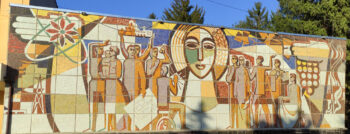
Palace of Culture, Rybnitsa
The Palace of Culture in Rybnitsa was constructed in 1972, distinguished by its remarkably unique architectural and artistic design. The large-scale mosaic adorning the front wall of the Palace of Culture bears the title “Moldova,” created by Mikhail Burya, an Honored Art Worker of the Moldavian SSR whose talent contributed significantly to this region’s monumental artistic heritage.
During this period in the Moldavian SSR, considerable attention was devoted to the aesthetic dimension of constructing new facilities, with the development of monumental art becoming a defining characteristic of the 1970s and 1980s throughout the region. This artistic movement, rooted in Socialist Realism, sought to express the conscious socialist worldview held by Soviet citizens, while specifically glorifying the humble working citizen — a theme clearly visible throughout the mosaic’s composition, which celebrates ordinary laborers and their contributions to building Soviet society.

House of Culture of Mokra Village
The mosaic panel titled “Awakening” decorates the facade of the House of Culture in Mokra village, a monumental artwork created in 1977 by artists I.V. Taburts and A.N. Kuzmin. This impressive mosaic spans an area of 110 square meters, making it one of the more substantial examples of monumental art found in the rural villages of Rybnitsa district.
The artwork is specifically dedicated to the revolutionary events of 1905, approached through figurative and narrative artistic methods. Within this mosaic composition, the artists embodied a visual story chronicling the peasant uprising, the collapse of the old social order, and the early steps toward collectivization, while symbolically reflecting the prosperity their native land achieved during the years of Soviet power.
Through fragmentary, multi-scale images depicting various episodes from the village’s history, the mosaic simultaneously presents both past and present moments in Mokra’s development. As a powerful symbol of the future, a fantastical tree-garden emerges as a distinctive bright color accent within the composition — representing hope and continued prosperity for generations yet to come, completing this ambitious narrative artwork that weaves together historical memory with utopian Soviet aspiration.
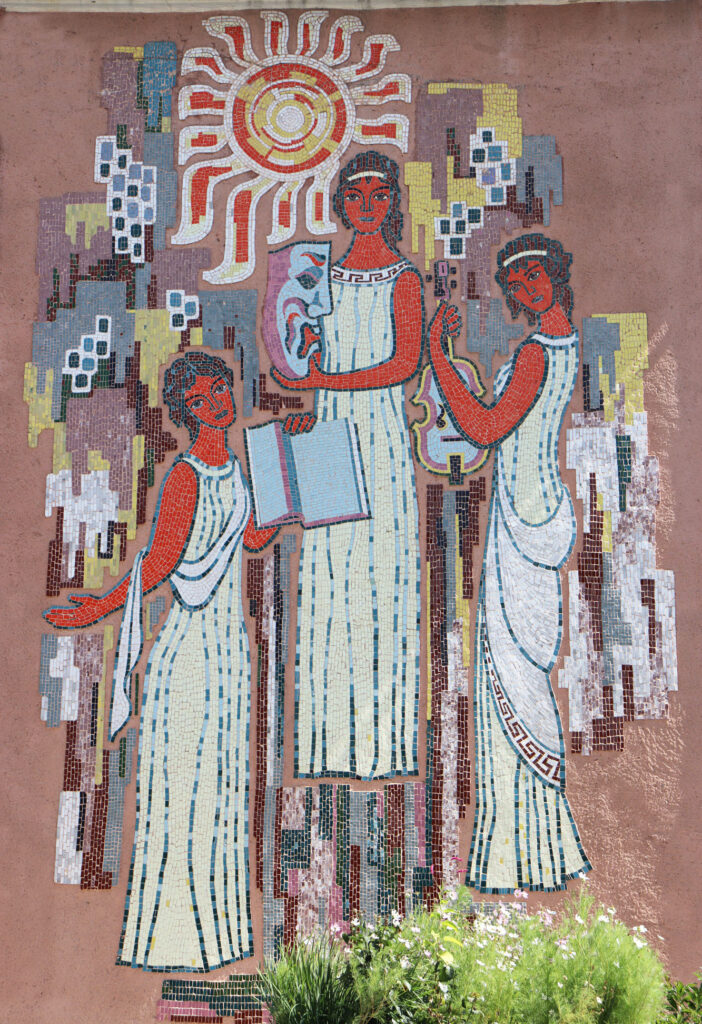
House of Culture in Popenki village
The facade of the House of Culture in Popenki village displays a mosaic panel titled “Muses,” presenting a beautifully composed artistic tribute to the realms of culture and learning. The mosaic depicts three muses, each holding distinct objects that symbolically represent different artistic and scholarly pursuits: a mask serves as the symbol of theater, a violin represents the world of music, and an open book embodies the pursuit of science and knowledge.
This thoughtfully composed artwork connects the village’s cultural center directly to broader themes of creative and intellectual achievement, suggesting through its imagery that the House of Culture serves as a place where theatrical performance, musical expression and scholarly pursuit can all flourish together under one roof — embodying the comprehensive vision of cultural enrichment that such institutions aimed to provide throughout Soviet-era rural communities.
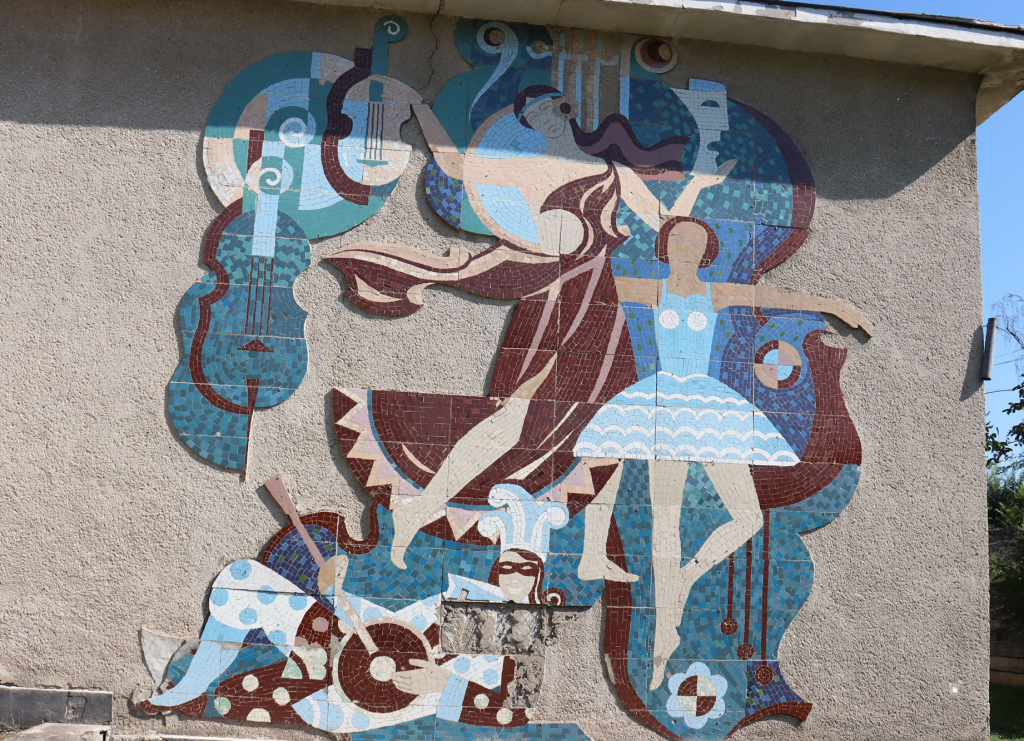
House of Culture in the Village of Vykhvatintsy
The House of Culture in Vykhvatintsy village was constructed in May 1967, with various skilled craftsmen invited from different regions specifically to perform the building’s finishing work. The distinctive mosaic decorating the facade was laid out by specialists brought in from Odessa around 1971, adding artistic sophistication to this rural cultural institution.
Today, a small portion of the mosaic has unfortunately suffered damage and destruction, yet the overall artistic narrative remains clearly legible to visitors. The composition depicts a ballerina captured mid-dance, alongside a harlequin figure playing a musical instrument that resembles either a dombra or a banjo. The panel additionally features a woman holding a violin in one hand while grasping a theatrical mask in the other — imagery that suggests this figure represents one of the ancient Greek muses, those legendary patrons of the arts and sciences whose symbolic presence connects this rural Soviet-era mosaic to a much older artistic and cultural tradition spanning millennia.

Bus Stop in the Village of Broshtyany
This distinctive bus stop in Broshtyany village represents another charming example of the Soviet-era tradition of incorporating monumental art into everyday public infrastructure throughout the Rybnitsa district. Following the broader pattern seen across the region, where even modest waiting areas received artistic mosaic decoration, this bus stop continues the delightful surprise of discovering genuine artistic expression in the most unexpected and humble of settings — transforming a simple roadside shelter into a small but meaningful piece of public art that brightens the daily commute for village residents and intrigues passing visitors alike.
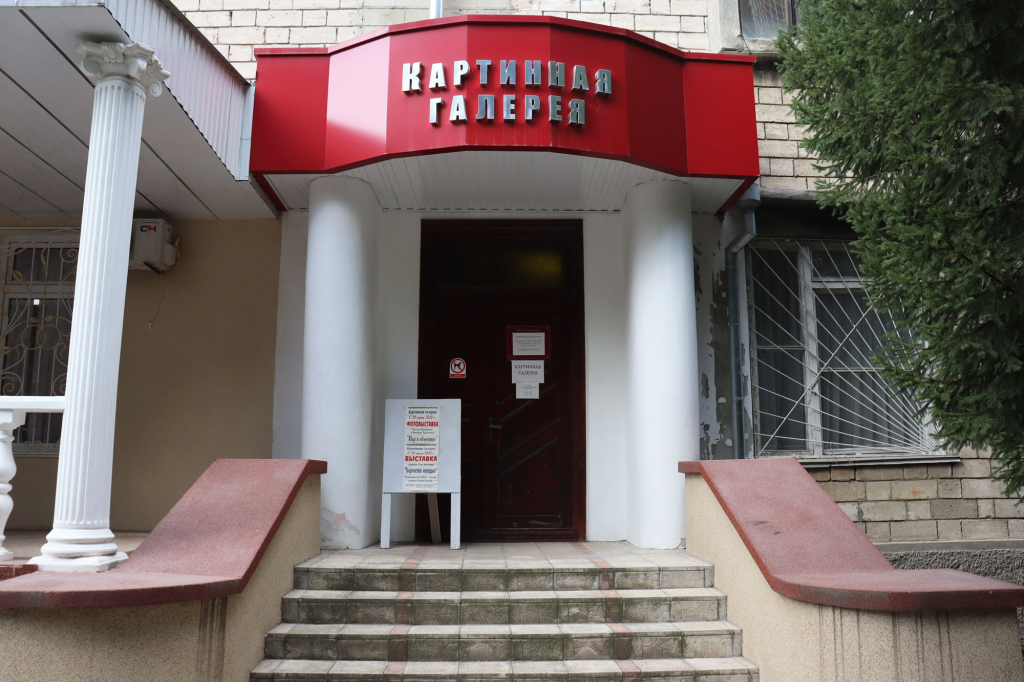
Art Gallery, Rybnitsa
On October 7, 1988, an exhibition hall opened within the Rybnitsa City Palace of Culture, providing the foundation upon which a full art gallery would later be established on January 1, 1991. This institution has since evolved into a genuine cultural and educational center, dedicated to collecting and exhibiting objects representing both material and spiritual culture of significant historical, scientific and artistic value.
Within the gallery’s two exposition halls, stationary exhibitions showcase works created by professional artists, talented amateur craftsmen and skilled photography specialists, organized and presented for the appreciation of visitors throughout the year. Beyond its primary artistic function, the gallery also houses a helpful tourist information point, where visitors can obtain free tourist maps, booklets and brochures covering destinations throughout Pridnestrovie, while also having the opportunity to purchase handmade souvenirs crafted by local artisans — making this gallery a valuable combined destination for both cultural enrichment and practical travel planning assistance.