 Skip to content
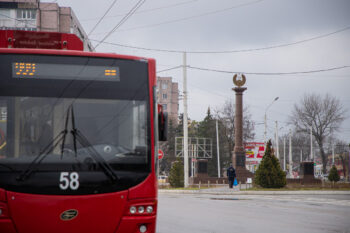
Trolleybus Sightseeing tour in Bendery
Trolleybus Sightseeing Tour of Bender
Climb aboard for one of the most unique urban experiences in Transnistria — the Trolleybus Sightseeing Tour of Bender — a fascinating 17 km journey through the historical heart of one of Pridnestrovie’s most storied cities. With 15 remarkable stops spanning centuries of military, architectural and cultural heritage, set aside 3–4 hours to fully absorb everything this extraordinary tour has to offer.
The history of Bender stretches back to ancient times, weaving together empires, battles, heroes and communities into a tapestry unlike any other in the region. From Ottoman fortresses to Soviet memorials, from tsarist monuments to triumphal arches — every corner of this city speaks of a past that shaped the present.
The tour departs from Liberation Square in the city center — the historic heart of Bender and the ideal starting point for understanding how this remarkable city developed over the centuries. Standing here, the layers of history feel tangible and alive.
Just 1.5 km away, the magnificent Transfiguration Cathedral (31 Sovetskaya Str., Bender) rises as one of the city’s most beloved architectural landmarks — a place of spiritual refuge and extraordinary beauty that has presided over Bender’s changing fortunes for generations.
After 480 meters, the open-air museum “History Hardened in Metal” (Liberation Square, Lenin Str., Bender) offers a unique and immersive encounter with military heritage — a remarkable collection of preserved equipment and installations that brings the region’s defining conflicts vividly to life under the open sky.
Continuing 2.5 km, the imposing Stele “City of Military Glory” at the intersection of Kotovskogo, Suvorova and Tiraspolskaya Streets stands as a proud declaration of Bender’s enduring place in the military history of Pridnestrovie.
Just 1 km further, the Memorial Sign commemorating the 20th Anniversary of the Russian Peacekeepers’ Introduction into Pridnestrovie (Kotovskogo Str.) marks a pivotal moment in the region’s modern history — a quiet but powerful tribute to those who helped bring stability to a land in conflict.
After 2.2 km, the deeply moving Memorial of Commemoration and Sorrow (Kotovskogo Str., Bender) invites visitors to pause and reflect — a solemn monument dedicated to all those who gave their lives in the defense of Pridnestrovie.
Just 2.1 km along, the Monument to Lieutenant General A.I. Lebed (Kotovskogo Str.) honors the commander of the 14th Russian Army — a figure whose role in the 1992 conflict remains one of the most significant in the modern history of the region.
After 1.1 km, the tour turns onto the historic Petra Panina Street — named after the general himself — where the Bust of General-in-Chief P.I. Panin stands in proud commemoration of the military leader who played a decisive role in the siege and capture of Bender in the 18th century.
Continuing 3.7 km, the Monument to the 55th Podolsk Infantry Regiment (Petra Panina Str.) pays tribute to one of the most distinguished military units in Russian imperial history — a regiment whose service in this region left an indelible mark on its identity.
Just 2.1 km further, the Monument to the Victims of the First World War (Petra Panina Str.) offers a reflective pause — a dignified tribute to those who fell on the battlefields of 1914–1918, ensuring their sacrifice is never forgotten.
After 240 meters, the Memorial Sign to R.N. Gerbel (Petra Panina Str.) honors General Rodion Gerbel of the Russian Imperial Army, who played a key role in the siege and storming of the Bender Fortress in 1770 — a name inseparable from the military history of this city.
Just 1 km further, the magnificent Triumphal Arch commemorating the 600th Anniversary of Bender (Ermakova Str.) stands as one of the city’s most visually striking landmarks — a grand architectural celebration of six centuries of unbroken urban history.
After 570 meters, the Monument to Field Marshal Prince G.A. Potemkin-Tavrichesky (Yermakova Str.) honors one of the most influential figures of the Russian Empire — the statesman and military commander whose vision transformed the entire southern region.
Continuing 910 meters, the Bender Military Historical Memorial Complex (Yermakova Str.) provides one of the most comprehensive and moving tributes to the city’s military heritage — a landmark that draws together the many threads of sacrifice and valor that define Bender’s identity.
The tour concludes at the deeply meaningful Memorial Sign to Women Defenders of Pridnestrovie (Petra Panina Str.) — a powerful and long-overdue tribute to the women who participated in the 1991 railway blockade, whose courage and determination helped shape the course of history in this remarkable region.

Liberation Square, Bendery
Liberation Square stands as the historical and administrative heart of Bendery, serving as the city’s central gathering point for generations. Within easy walking distance of the square, visitors will find some of the city’s most important attractions clustered conveniently nearby, making this an ideal starting point for exploring Bendery’s rich heritage.
Closed to vehicular traffic, the square itself has become a traditional venue for both citywide and national celebrations, regularly filling with crowds during festive occasions throughout the year. This pedestrian-friendly space embodies the civic identity of Bendery, functioning as a true public square where the community comes together to mark significant moments in the life of the city and the wider republic alike.

Transfiguration Cathedral, Bendery
A major reconstruction of Bendery began once the city became part of the Russian Empire, with urban planners deciding to rebuild the city at some distance from the original Bendery Fortress. In 1814, authorities decided to relocate the Dormition and Nikolsky churches to this new city center, but their dilapidated condition ultimately led to their demolition instead. The city then turned its attention to constructing an entirely new Transfiguration Cathedral, with His Grace Dimitrios, Bishop of Bendery and Akkerman, serving as the project’s founding figure.
The cathedral’s foundation stone was laid on August 22, 1815, and Bishop Dimitrios personally consecrated the building in 1827 — though construction itself proceeded at a notably slow pace. The bell tower wasn’t completed until 1832, and remaining construction work dragged on until 1840. Interestingly, the funding for completing construction came through a rather worldly arrangement: the church warden secured permission to build commercial shops surrounding the cathedral, with the resulting rental income providing the necessary financial support. This commercial activity left a lasting mark on the area, transforming the cathedral’s surroundings into a thriving trade center — indeed, the Bendery city market continues to operate nearby to this very day.
For many years, only a handful of small bells hung in the cathedral’s bell tower, until 1911 brought a significant upgrade: a large 3-ton bell, cast specifically at a factory in Nemirov. Remarkably, the cathedral’s interior remained unpainted well into the early 20th century — despite periodic repair work, the interior decoration project was never fully completed during this period. This changed in the early 1930s, when clergy decided to commission proper interior painting and invited the celebrated Moldavian artist and sculptor Alexandru Plamadeala to undertake the work. The artist arrived in Bendery around May 1934 to begin this ambitious project, bringing along four talented apprentices: V. Polyakov, V. Nechaeva, N. Kolyadich and A. Madval. Many of Plamadeala’s frescoes have survived remarkably well to the present day, including depictions of “Constantine,” “Helena,” “the Sun God,” and images of the twelve apostles — a lasting artistic legacy from this productive collaboration.
The cathedral suffered significant damage during the Great Patriotic War, when the building was struck by an artillery shell. The resulting fire destroyed both the iconostasis and the cathedral’s archive, permanently erasing invaluable historical information about the parish and city’s pre-war life. In 1948, recognizing its architectural and historical significance, the state placed the cathedral under official protection as an architectural monument dating to the early 19th century — ensuring this resilient survivor of war and time would be preserved for future generations.

"History Hardened in Metal" Open-Air Museum
In 2003, to mark the city’s 59th anniversary, an unusual and genuinely unique museum titled “History Hardened in Metal” was established within the recreation area of Liberation Square. Every single forged element on display was hand-crafted by A.A. Alekhin, an employee of the Bendery Local History Museum, whose dedicated craftsmanship brought this remarkable outdoor exhibition to life.
The museum presents a panoramic display of metal figures and compositions, each telling a piece of the major historical events that have shaped Bendery’s story over the centuries. Among the museum’s standout pieces, visitors will find the historical coat of arms of Bendery rendered in metal, a boat symbolizing the long tradition of navigation along the Dniester River, and a locomotive bearing the evocative Soviet-era inscription “For the Power of the Soviets!” — together creating an open-air gallery that connects visitors to the city’s past through tangible, artistically crafted metalwork.

Stele "City of Military Glory"
On June 13, 2012, the President of the PMR bestowed upon Bendery the honorary title of “City of Military Glory,” recognizing the courage, perseverance and mass heroism displayed by the city’s defenders in their ongoing struggle for the freedom and independence of the Fatherland. To commemorate this distinction, the stele “City of Military Glory” was officially unveiled in Bendery on May 6, 2015, timed to coincide with the 70th anniversary of the Great Victory in the Great Patriotic War.
The monument stands prominently in front of the Memorial of Commemoration and Sorrow, positioned so that it remains clearly visible to everyone entering the city — establishing itself as one of Bendery’s defining architectural landmarks. Four columns surrounding the central structure display historical dates connected to the heroic past of Bendery, creating a timeline of the city’s military legacy carved directly into stone.
At the heart of the composition rises the central stele itself — a column of striking red granite, crowned with the coat of arms of the Pridnestrovian Moldavian Republic cast in metal. At its base, a plate bears the official text of the Presidential Decree conferring the “City of Military Glory” status upon Bendery, while the reverse side features another plate displaying the city’s own coat of arms — together forming a complete and dignified tribute to Bendery’s recognized military heritage.
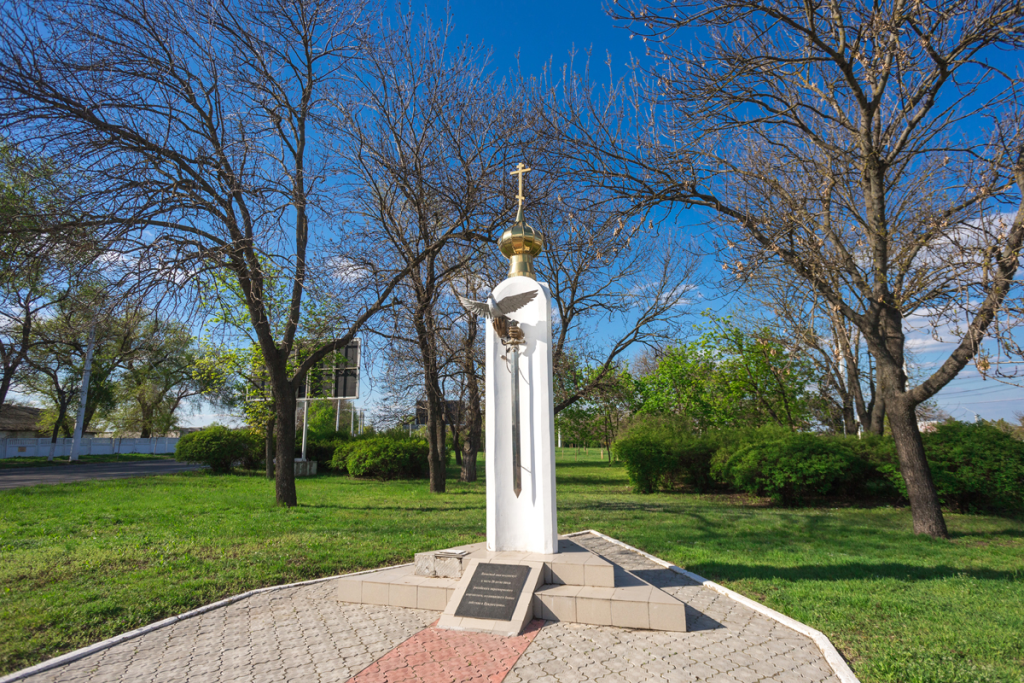
Memorial Sign Commemorating the 20th Anniversary of the Russian Peacekeepers' Introduction into Pridnestrovie
This memorial sign, commemorating the 20th anniversary of the introduction of Russian peacekeepers into Pridnestrovie, was established in Bendery at the initiative of the Russian contingent of the Joint Peacekeeping Forces. The project brought together the broader community in a genuine collective effort — residents of Bendery, alongside local enterprises throughout the city, actively participated in fundraising to make the monument’s installation possible.
Positioned thoughtfully in front of the Memorial of Commemoration and Sorrow, the sign was officially unveiled on July 28, 2012, creating a meaningful dialogue between this tribute to peacekeeping efforts and the nearby memorial honoring those affected by the 1992 conflict. Together, these two monuments form a powerful statement about Bendery’s journey from conflict toward lasting peace and stability.

Memorial of Commemoration and Sorrow, Bendery
In 1992, the entrance to the city from Tiraspol became the scene of intense fighting between the defenders of Pridnestrovie and invading armed units from Moldova. In recognition of this profound loss, it was decided to establish a permanent place of remembrance here for the fallen residents of Bendery — the Memorial of Commemoration and Sorrow. The first element of the memorial was unveiled on June 19, 1993, marking the first anniversary of the Bendery tragedy: a restored infantry fighting vehicle, whose crew had perished during the earliest days of the battle for the city. An eternal flame was lit before this combat vehicle, ensuring the memory of those losses would never be extinguished.
In 1995, an open chapel crowned with an Orthodox cross was added to the memorial complex. The chapel houses a bell weighing more than 430 kg, crafted in Moscow at the Likhachov Plant in cooperation with the Society for Old Russian Musical Culture. An inscription on the inside of one of the chapel’s arches reads: “In blissful repose, eternal rest grant, O Lord, unto your servants, soldiers departed on the battlefield, and may they forever be remembered.” In total, 489 people lost their lives during the spring and summer of 1992 in Bendery — both defenders of Pridnestrovie and 132 civilians caught in the conflict.
For the 6th anniversary of the Bendery tragedy in 1996, an additional memorial sign was unveiled at the site: five reinforced concrete structures bearing fragments of marble inscribed with the names of those who died in Bendery during that fateful summer. Surrounding the monument, poignant inscriptions speak directly to visitors: “You fell in Bendery, but you are not forgotten! You are remembered not only by granite slabs” and “Thank your lucky stars you are alive and bow down to the fallen for it” — words that capture both the weight of loss and the enduring gratitude owed to those who gave everything in defense of their homeland.

Monument to the Commander of the 14th Russian Army, Lieutenant General A.I. Lebed
The most recent addition to the Memorial of Commemoration and Sorrow is a monument honoring Lieutenant General Alexander Ivanovich Lebed, commander of the 14th Army of the Russian Federation, unveiled in 2012. Taking command of the army in the midst of active hostilities, Lebed played a crucial and decisive role in compelling the Republic of Moldova toward peace negotiations, ultimately helping bring an end to the bloodshed that had engulfed the region.
This monument stands as a tribute to a military leader whose intervention at a critical moment helped pave the way toward the stability that Pridnestrovie has known in the decades since, completing the memorial complex’s powerful narrative arc from conflict and loss toward eventual peace.

Bust of General-in-Chief P.I. Panin
On August 29, 2010, in commemoration of Bendery’s liberation from Turkish rule, a monument honoring Count Petr Ivanovich Panin was unveiled at the Main Gate of the Bendery Fortress. The monument stands along a street that city authorities renamed in honor of this distinguished Russian commander, recognizing his significant military achievements connected to the city’s history. The bust itself rests upon a granite pedestal positioned against the fortress’s closed chapel, stylized to evoke the artistic traditions of 18th-century monuments.
Panin dedicated more than 35 years of his life to military service within the Russian Imperial Army, participating in campaigns against the Swedes and Crimean Tatars while distinguishing himself on the battlefields of the Seven Years’ War. In recognition of his military service, in 1769, during the Russian-Turkish War, Empress Catherine II appointed him commander of the 2nd Army, charged with the critical mission of capturing Bendery and securing Russia’s southern border.
On September 15, 1770, Panin’s troops launched a decisive assault on the formidable fortress, ultimately capturing it after fierce and costly fighting. Despite this significant military achievement, the heavy losses sustained during the assault drew a negative reaction from the Empress, prompting Panin to resign his command. Nevertheless, many military engineers have since regarded the siege of Bendery as an exemplary military operation from beginning to end — a testament to Panin’s tactical skill, even amid the campaign’s tragic human cost.

Monument to the 55th Podolsk Infantry Regiment in Bendery
In 1912, residents of Bendery celebrated a significant double anniversary: the centenary of victory in the Patriotic War of 1812 and the centenary of Bessarabia’s incorporation into Russia. To mark this momentous occasion, the inauguration of a monument to Russian military glory was specifically timed to coincide with these celebrations. The funds necessary for the monument’s construction were raised through the dedicated efforts of soldiers and officers of the 55th Podolsk Infantry Regiment, whose own military legacy the monument would come to honor.
Originally, the monument was positioned within the Bendery Fortress itself, situated alongside the Alexander Nevsky Military Church. During the Soviet era, however, the monument was relocated from the fortress to what is now Panina Street, where it continues to stand to this day — preserving the memory of this distinguished regiment even as its physical location shifted with the changing tides of history.

Monument to the Victims of the First World War
This monument honors the valor and sacrifice of Russian soldiers and officers who lost their lives in Pridnestrovie during the First World War. Located within the garden named after R. Gerbel at the walls of the fortress, the monument was specifically unveiled to mark the 95th anniversary of the famous 1916 offensive of the Southwestern Front — the campaign that would later become known to history as the Brusilov Breakthrough.
The First World War left its mark deeply on Bendery itself. The city served as the departure point for the 55th Podolsk Infantry Regiment as they set off for the battlefields, and following Romania’s defeat, Bessarabia transformed into frontline territory, drawing waves of refugees and wounded soldiers into the city. Some of these wounded found shelter and care in the People’s Lecture Hall, which had been specially adapted to serve as an infirmary during this difficult period. The significance of Bendery’s wartime role was further underscored when Emperor Nicholas II himself visited the city in 1916 during his trip through the region, lending imperial attention to the sacrifices being made on this corner of the front.

Memorial Sign to R.N. Gerbel
The monument to General Rodion (Rudolf) Gerbel was unveiled on October 8, 2011, fittingly timed to coincide with the 603rd anniversary of Bendery. Swiss by origin, Gerbel served within the Russian army as a specialist in military engineering, bringing his technical expertise to bear on one of the most decisive campaigns in the city’s history.
It was Gerbel who developed the strategic plan for the 1770 siege of Bendery Fortress — a plan executed with remarkable precision and skill. In just eight weeks, his engineers successfully constructed a tunnel reaching all the way to the fortress walls, where they laid 400 pounds of gunpowder. The resulting explosion proved devastatingly effective, filling in the defensive ramparts and inadvertently creating a kind of bridge across which Russian troops launched their attack, ultimately securing Bendery for the Russian Empire. Gerbel’s engineering genius thus played a pivotal, if largely behind-the-scenes, role in one of the most significant military victories in the city’s long and storied history.
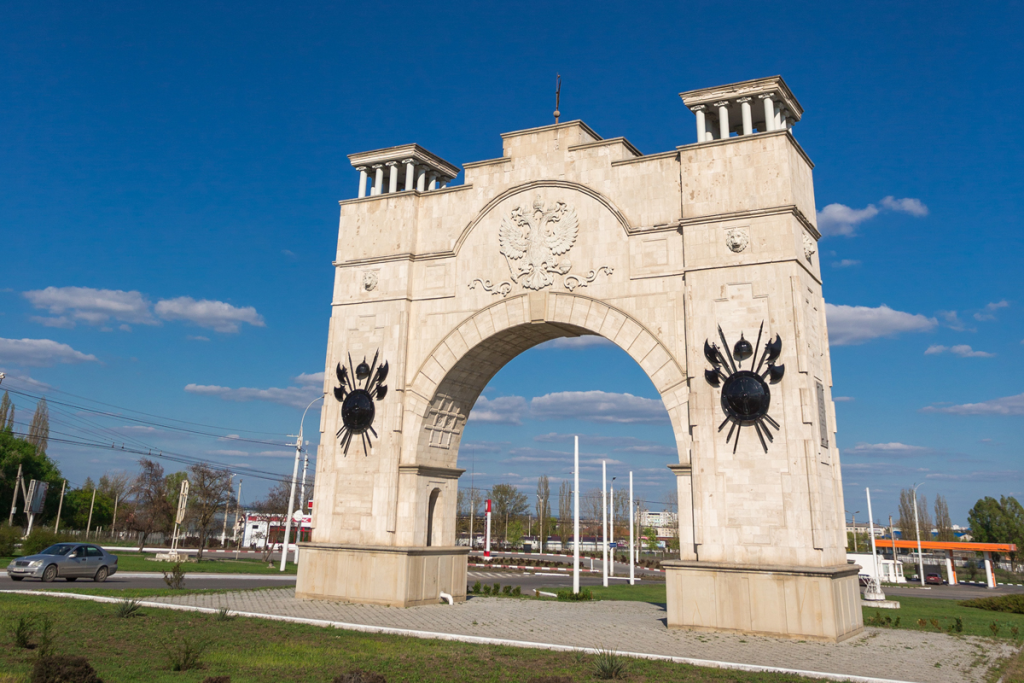
Triumphal Arch Commemorating the 600th Anniversary of Bendery
The Triumphal Arch opened in Bendery on October 7, 2008, on the eve of the city’s momentous 600th anniversary celebration. Positioned on Ermakova Street, almost precisely at the city’s entrance, the arch was designed by architects V. Frolkov, B. Filimonov and I. Kibich, who together created a monument worthy of marking such a significant historical milestone.
Every metal element of this impressive structure was handcrafted by A.A. Alekhin, an employee of the Bendery Local History Museum whose meticulous craftsmanship brought the architects’ vision to life. The top of the Triumphal Arch features a striking bas-relief depicting a double-headed eagle, while the supporting columns are adorned with ornamental military attributes — including a helmet, pole-axe and bardiche — symbolically representing the glory and tradition of Russian weaponry throughout history.
The arch’s front side deliberately faces the entrance to the city, a design choice that honors an ancient architectural tradition in which triumphal gates always oriented toward the road leading into the city they celebrated. Through this thoughtful nod to historical convention, the architects ensured that the monument would welcome every visitor entering Bendery in the same manner that triumphal arches have greeted travelers for centuries.
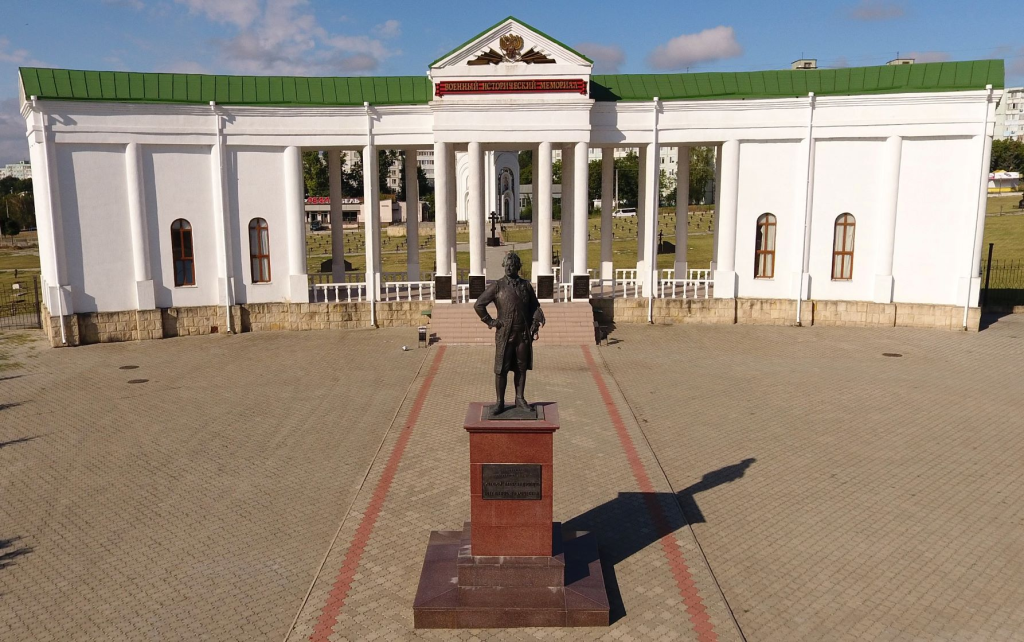
Monument to Field Marshal, Prince G.A. Potemkin-Tavrichesky
The entrance to this historical complex has been thoughtfully designed in the form of an elegant colonnade, before which stands a monument honoring G.A. Potemkin-Tavrichesky — one of the most celebrated and influential statesmen in Russian imperial history. This dignified architectural ensemble pays tribute to the visionary leader whose efforts to develop and secure Russia’s southern territories left an enduring mark on the entire region, including the lands that would become Pridnestrovie.

Bendery Military Historical Memorial Complex
The Bendery Military Historical Memorial Complex opened its doors on October 7, 2008, erected on the grounds of an old military cemetery where countless soldiers of the Russian Imperial Army — fallen across the wars of the 18th through 20th centuries — had been laid to rest. The site’s history as a burial ground traces back to the early 19th century, when a military hospital operated nearby and a designated area for burying the fallen gradually evolved into an officially recognized military cemetery. By the early 20th century, the cemetery had been properly fenced and featured an impressive high stone gate marking its entrance.
In the post-war period, however, the cemetery became hemmed in by surrounding urban development and fell into a state of neglect and desolation. This changed in accordance with a Decree issued by PMR President I.N. Smirnov on November 8, 2006, when the Ministry of Internal Affairs of the PMR initiated a comprehensive restoration and construction project to transform the site into a proper military and historical memorial. At the very outset of construction, with support from the Tiraspol-Dubossary diocese, a massive black granite cross was erected at the center of the future memorial — a powerful symbol of faith and eternal rest for all those buried there. By the summer of 2007, the foundation had been laid for the stone Chapel of the Icon-Bearing Image of Jesus Christ, with construction of the colonnade marking the main entrance to the necropolis following that autumn.
The complex’s entrance takes the form of an elegant colonnade, fronted by a monument to G.A. Potemkin-Tavrichesky, the celebrated Russian statesman. Beyond the colonnade, three distinct pathways guide visitors through the memorial grounds: the left path leads to the Historical Sector, the right to the Foreign Sector, while the central path — known as the Generals’ Alley — leads directly to the Central Cross and the Church of the Icon-Bearing Image of Jesus Christ. Large granite slabs line both sides of this central path, honoring 11 Russian military commanders buried within the memorial grounds, including several commandants of the Bendery Fortress — T.I. Zbievski, Ph.I. Cannabich, M.M. Olshevsky and A.I. Wedemeyer — alongside military engineer E.K. Foerster, Tiraspol barracks builder P.P. Dubelt, Major Generals F.P. Luzanov, N.P. Mikhailov, B.S. Soecki and F.P. Dolgovosaburov, and Bendery Fortress platzmajor I.I. Batyrev.
Flanking the chapel on both sides lie the memorial’s two largest burial sectors, where evenly arranged rows of polished black granite plates bear the carved names of more than 5,000 soldiers and officers representing 110 regiments and units of the Russian Imperial Army, including 21 units specifically from the Bendery garrison. Beyond these Russian military graves, the memorial also honors soldiers from foreign armies — French, Hungarian and Romanian troops who lost their lives in Bendery during the first half of the 20th century, reflecting the international scope of conflicts that have touched this city.
The stone Chapel of the Icon-Bearing Image of Jesus Christ was constructed specifically to honor a church of the same name and dedication that once served the 55th Podolsk Infantry Regiment but had not survived to the present day. This chapel proved so beloved among residents and visitors alike that the Holy Synod’s decision in 2010 elevated its status to that of a full church. Granite plates adorning the church’s walls trace key milestones in the Podolsk Regiment’s history, while also recording the names of those who perished during the historic 1770 storming of the fortress, alongside a comprehensive list of all Russian Imperial Army regiments that participated in that decisive campaign.
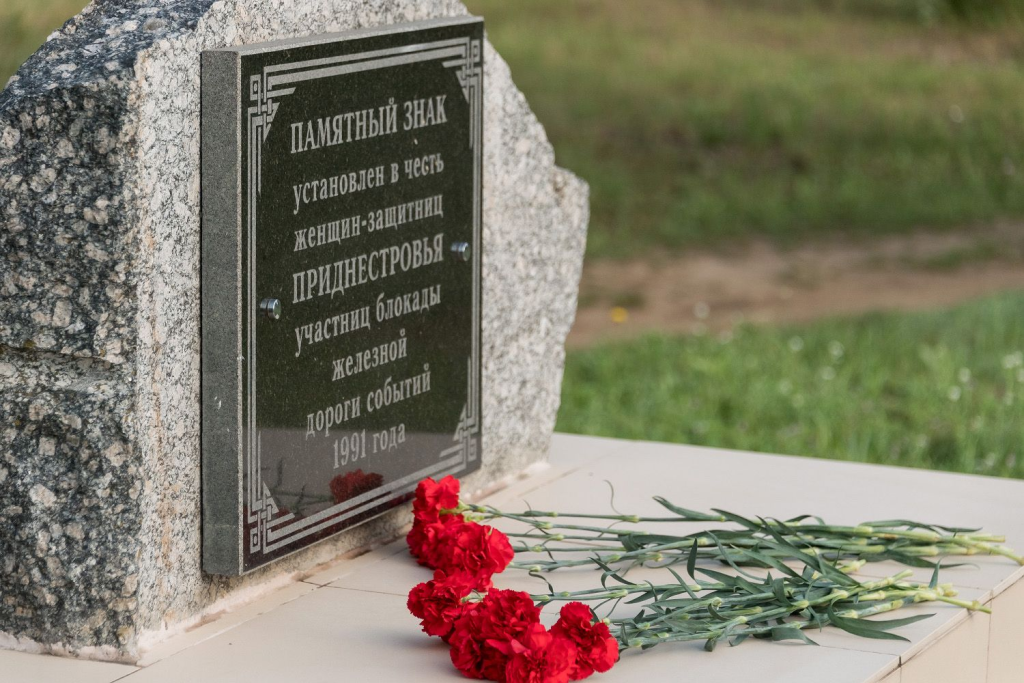
Memorial Sign to Women Defenders of Pridnestrovie, Participants of the 1991 Railway Blockade
In 2010, to mark another anniversary of the founding of the Women’s Strike Committee, a memorial sign honoring the defenders of the PMR was unveiled on Panin Street in Bendery, positioned in close proximity to the railway track itself — the meaningful location chosen deliberately to connect the monument with the historic events it commemorates. The work of sculptor Tatyana Sergeeva, this memorial pays tribute to the remarkable courage of the women who stood alongside men in defense of their young republic’s independence.
The founding date of the Women’s Strike Committee — September 1, 1991 — marked a pivotal moment when women joined their male counterparts in actively defending Pridnestrovie’s sovereignty. During a pivotal rally, these women made a decision that would prove fateful for the entire republic: they resolved to occupy the railway tracks and block all rail traffic until Chisinau agreed to fulfill the demands of the movement’s participants. This bold action gave rise to what would later be remembered in the republic’s historical annals as the “rail war” — a defining episode in Pridnestrovie’s struggle for self-determination, and one in which women played an absolutely central and courageous role.