 Skip to content

Trolleybus Sightseeing tour in Tiraspol
Trolleybus Sightseeing Tour of Tiraspol
See the heart of Pridnestrovie’s capital in a whole new way on the Trolleybus Sightseeing Tour of Tiraspol — a scenic 37 km journey through the most significant landmarks, parks, monuments and institutions of this remarkable city. With 13 carefully chosen stops and a knowledgeable guide narrating the city’s rich history along the way, plan for a rewarding 3–4 hours of discovery.
The tour departs along the iconic Pokrovskaya Street, sweeps past the verdant Catherine Park, continues to the Monument to the Soldiers-Aviators, then returns through Odesskaya Street and Victory Park back to the city center — a route that captures the full sweep of Tiraspol’s urban identity in a single unforgettable journey.
The tour begins at the Tiraspol United Museum (42 Pokrovskaya Str., Tiraspol) — one of the city’s most comprehensive cultural institutions, housing collections that span the natural history, archaeology and cultural heritage of Pridnestrovie. An ideal starting point for understanding the city before exploring it firsthand.
Just 180 meters away, the magnificent Memorial Complex of Glory (Pokrovskaya Str., center) commands the heart of Tiraspol with solemn grandeur. This powerful ensemble of monuments and eternal flame honors the heroes who gave their lives in the defense of the homeland — a place of deep civic pride and collective memory that every visitor to Tiraspol should experience.
After 1.1 km, the route passes the Former Headquarters of Cavalry Brigade Commander G.I. Kotovsky (34 Manoilova Str., Tiraspol) — a historically significant building connected to one of the most colorful and celebrated military figures of the Soviet era, whose name and legacy are woven deeply into the fabric of this city.
Just 870 meters further, the House of Soviets (101 Pokrovskaya Str., Tiraspol) presents one of the finest examples of Soviet civic architecture in the region — an imposing building that once served as the seat of local government and remains a defining feature of the city’s central streetscape.
After 1.1 km, the Comedy Theatre named after N.S. Aronetskaya (130 Pokrovskaya Str., Tiraspol) adds a welcome cultural flourish to the route — one of Pridnestrovie’s most beloved theatrical institutions, named after its legendary founding director and continuing to delight audiences to this day.
Continuing 1.7 km, the lush Botanical Garden (50 Mira Str., Tiraspol) offers a breath of fresh air — a beautifully maintained green oasis in the heart of the city, home to an impressive collection of plants and trees that provides a serene natural counterpoint to the urban monuments surrounding it.
After 2.9 km, the Monument to Aviators (Yunosti Str., Tiraspol) pays tribute to the brave military pilots whose skill and courage defined some of the most dramatic chapters in the region’s wartime history — a striking landmark that stands proud against the Tiraspol skyline.
Just 2.1 km further, the expansive Pobeda Park (Victory Park, Mira Str., Tiraspol) invites a moment of reflection and relaxation — a beloved green space dedicated to the memory of victory in the Great Patriotic War, where locals and visitors alike gather to stroll, reflect and enjoy the city’s natural beauty.
After 1.1 km, the imposing campus of Shevchenko Pridnestrovian State University (128a and 128b Pokrovskaya Str., Tiraspol) represents the intellectual and academic heart of the republic — the region’s principal university, whose grand buildings speak of the value placed on education and knowledge in Pridnestrovian society.
Just 1.3 km away, the Post of Pridnestrovie (17 Lenin Str., Tiraspol) offers a fascinating and somewhat unexpected stop — a living institution of the republic’s independent postal system, whose distinctive stamps and services have become collector’s items and cultural curiosities in their own right.
After 710 meters, the Building on Pokrovskaya Street — now housing the TiraMed Medical Center (75 Pokrovskaya Str., Tiraspol) presents a striking piece of Soviet-era architecture whose elegant facade continues to enrich the visual landscape of the city’s main thoroughfare.
Continuing 870 meters, Suvorov Square (Pokrovskaya Str., center, Tiraspol) forms the historic and symbolic heart of the city — named after the legendary Russian military commander Alexander Suvorov, the founder of Tiraspol himself. Standing here, surrounded by the city’s most iconic buildings, one feels the full weight of history that makes this capital so distinctive.
The tour concludes 1.1 km further at the Building of the Supreme Council and Government of the Pridnestrovian Moldavian Republic (45 Pokrovskaya Str., Tiraspol) — the seat of power of the republic and perhaps the most politically significant building in all of Pridnestrovie. A grand and fitting finale to a tour that has journeyed through the very soul of this remarkable capital city.

Tiraspol United Museum
The Tiraspol United Museum was officially established on May 8, 1958, founded by order of the Ministry of Culture of the Moldavian SSR. Today, this institution operates as a comprehensive association bringing together four distinct museums, all sharing a common collection fund while specializing in different areas of knowledge and heritage. The main historical and local history museum focuses on a historical profile, while the department of nature specializes in natural science. The “Tiraspol Fortress” branch covers military-historical subjects, the memorial house-museum of academician Nikolai Dmitrievich Zelinsky addresses natural science from a more personal, biographical angle, and the picture gallery rounds out the collection with an art profile, together creating a remarkably diverse cultural institution under one administrative umbrella.
The administration of the Tiraspol United Museum is now centrally located in the heart of Tiraspol, housed within a building that itself holds significant historical value as a recognized monument in the Art Nouveau style. Constructed in the 1870s, the building originally served the Nobility Assembly of Tiraspolsky Uyezd, hosting the social and administrative gatherings of the local aristocracy. During the Soviet period, the building’s purpose shifted repeatedly — at various times serving as a theater, then housing party bodies, before becoming, during the 1960s and 1970s, the home of political education activities and the “Znanie” (Knowledge) association.
The building carries additional historical weight as the site where, in 1921, the prominent Soviet statesman and Civil War commander Mikhail Frunze delivered a notable speech. Following this appearance, Frunze was elected an honorary deputy of the Tiraspol Uyezd Council, an honor commemorated today through a bas-relief and memorial plaque mounted on the building’s wall facing the Memorial of Glory — a lasting tribute connecting this historic structure to a significant figure of early Soviet history.
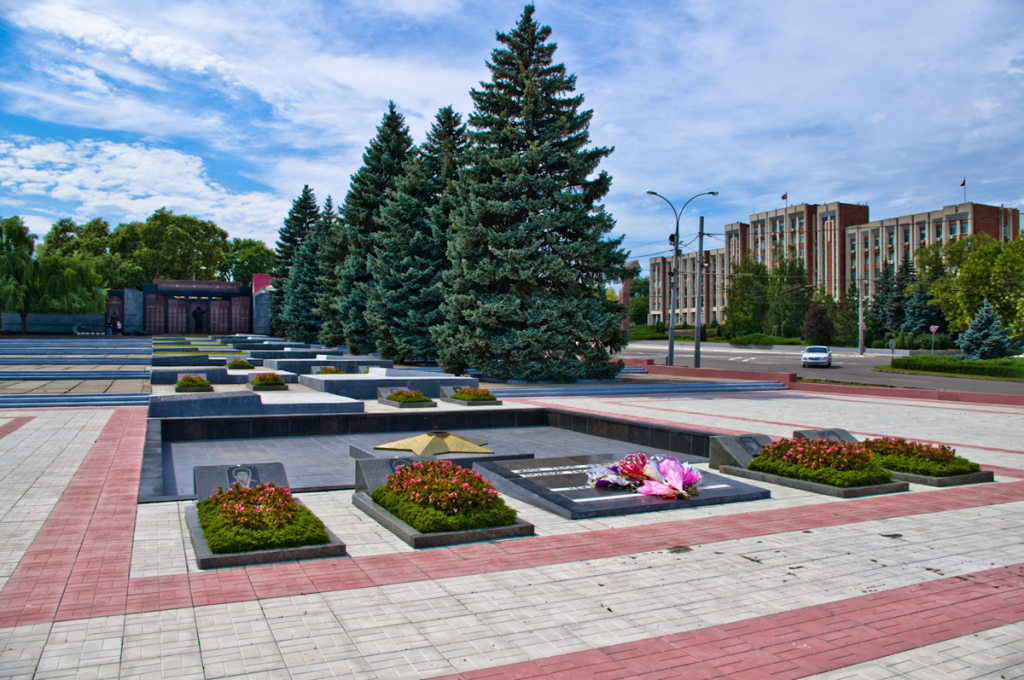
Memorial Complex of Glory
The Memorial Complex of Glory opened on February 23, 1972, deliberately timed to coincide with the Day of the Soviet Army and Navy. On that significant date, a ceremonial reburial took place, honoring the remains of Soviet soldiers and officers who were natives of Pridnestrovie and had fallen during the Great Patriotic War, alongside soldiers who lost their lives specifically during the liberation of the Pridnestrovian region itself.
Over the years that followed, the memorial expanded its role, becoming the final resting place for those who died during the war in Afghanistan, as well as for soldiers and civilians killed during Moldova’s armed aggression against Pridnestrovie in 1990-1992. Today, marble slabs throughout the memorial immortalize the names of 1,252 reburied soldiers, including four Heroes of the Soviet Union — a remarkable concentration of military distinction commemorated at this single site.
A T-34-85 tank stands prominently within the memorial, serving as a powerful monument to fallen soldiers of the Great Patriotic War. This particular tank has a genuinely remarkable history: serving as part of the 7th Guards Mechanized Corps, it participated in the liberation of Ukraine, Moldavia, Bulgaria and Hungary. During the Budapest Offensive, the tank sustained damage at Lake Balaton, and in April 1945, this battle-worn war machine was transported to Tiraspol, where it now rests as a tribute to those who fought in it. Beneath the tank lies a buried capsule containing earth brought specifically from Mamayev Kurgan in the Hero City of Volgograd — formerly Stalingrad — creating a symbolic connection between this memorial and one of the most significant battlefields of the entire war.
In October 2011, the St. George Chapel was added to the memorial complex, further enriching its spiritual dimension. Another important element is the monument to soldier-internationalists killed in Afghanistan, opened in 1995 by Lieutenant General Alexander Lebed, commander of the 14th Guards Combined Arms Army of Russia — a figure whose own historical significance in the region adds further weight to this dedication.
By the end of the 2000s, the complex underwent substantial reconstruction, during which a Wall of Memory was constructed, bearing the names of all defenders of Pridnestrovie and civilians killed during the 1990-1992 armed aggression by the Republic of Moldova. This reconstruction also saw the installation of a poignant sculpture, “Grieving Mother,” created by artist V. Tkachenko — a moving addition that gives universal human expression to the grief and loss commemorated throughout this comprehensive and continually evolving memorial complex.
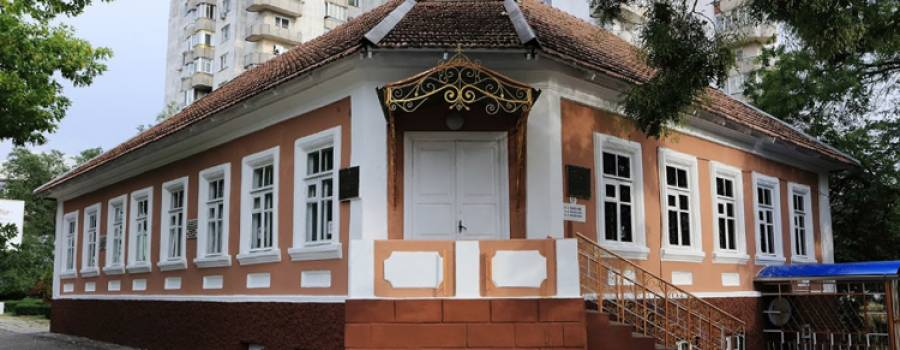
The Building of the Former Headquarters of the Cavalry Brigade G.I. Kotovsky
This historic building, located not far from the central post office, was originally constructed as the Hotel “Paris,” serving travelers and visitors to Tiraspol during an earlier era. The building’s role shifted dramatically in 1920, when it became the headquarters for the cavalry brigade commanded by Grigory Kotovsky, one of the most celebrated and colorful commanders of the Red Army.
During this period, Kotovsky’s forces played a significant role in the broader military campaigns of the Russian Civil War, taking part specifically in the overthrow of the Armed Forces of South Russia under the command of General A.I. Denikin. This connection to one of the pivotal military figures of the early Soviet era gives the former hotel building a significance that extends well beyond its original commercial purpose, marking it as an important site in the broader narrative of Tiraspol’s revolutionary and military history.

House of Soviets
The House of Soviets stands as one of the most recognizable and majestic buildings in all of Tiraspol, its scale genuinely impressive — the structure contains more than 200 rooms, with the main hall alone spanning nearly 300 square meters. This four-story building was constructed during the 1950s according to a design by architect V. Alexandrov, intended to house local government bodies. Construction employed the most advanced technologies available in the Soviet Union at the time, and the resulting building became a classic example of the Stalinist Empire architectural style.
The project’s designers drew inspiration from the classical order system associated with Napoleonic France, while also looking to Moscow’s famous high-rise buildings for additional inspiration. This blend of influences manifests clearly in the building’s facade, where a powerful ten-column portico commands attention, crowned by a sharp spire topped with a star. Notably, unlike many examples of Stalinist Empire architecture found throughout the former Soviet republics, the House of Soviets has preserved its complete decorative scheme and Soviet symbolism intact, offering visitors a remarkably well-preserved window into this distinctive architectural era.
Today, the building continues serving its original intended function, housing the city’s governmental bodies — the Council of People’s Deputies and the State Administration. The clock installed on the building dates to October 1974, added specifically to commemorate the 70th anniversary of the Moldavian ASSR. Master clockmakers Vladimir Fedorovich Zibarov and Valentin Akimovich Potapov crafted this timepiece, whose chiming mechanism originally relied on a bell sourced from the Kitskany Monastery — though in 1989, this bell was returned to the monastery. In its place, the Kirov Plant manufactured a new bell weighing 120 kg with a more melodious tone, while the “Elektromash” plant produced the electric motor needed to power the mechanism.
The building has even made its mark in popular culture: in one memorable episode of the Soviet film comedy “Не имей 100 рублей…” (“Don’t Have 100 Rubles…”), the House of Soviets played the role of the Ministry of Finance, where the film’s characters bring a discovered treasure — adding a touch of cinematic fame to this already architecturally significant landmark.
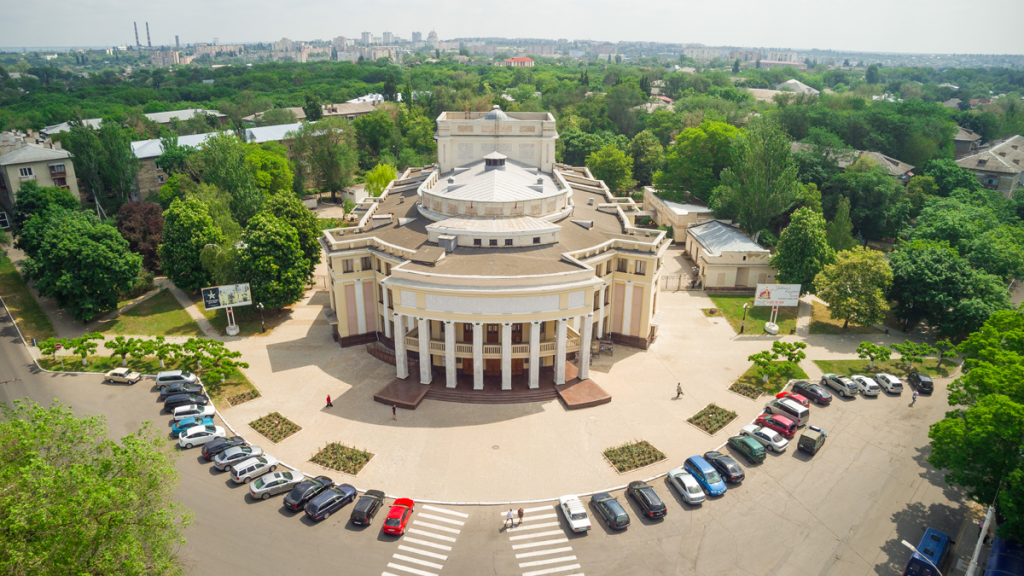
Comedy Theatre named after N.S. Aronetskaya
In 1929, Tiraspol became the capital of the Moldavian Autonomous SSR, sparking an architectural boom that would eventually grant the city a magnificent theater building, designed by architect Grigory Gotgelf in the Neoclassicism style. Beginning in 1936, three distinct theatrical troupes operated under this single roof — Russian, Ukrainian and Moldavian — reflecting the multicultural character of the city’s cultural life during this period.
The theater’s continuous operation was interrupted in the 1940s, when the building suffered severe damage during the war years. Restoration efforts finally succeeded in 1963, marking the theater’s revival — a revival inextricably linked with the name of its first director, Honored Artist of the MSSR and dedicated teacher N.S. Aronetskaya. Her innovative productions, marked by vibrant acting, quickly earned recognition from Soviet critics, establishing the theater’s artistic reputation. In recognition of Nadezhda Stepanovna Aronetskaya’s outstanding contributions to the development of Pridnestrovian theater, the Tiraspol theater was officially named in her honor in 2001.
The theater’s building holds connections to two pivotal dates in Pridnestrovian history. First, it was here, on April 12, 1944, that a red banner was raised, signaling the city’s liberation from Nazi invaders. Second, and perhaps even more historically significant, this very building witnessed the proclamation of the Pridnestrovian Moldavian SSR as part of the Soviet Union on September 2, 1990, during the 2nd Extraordinary Congress of Deputies of all levels of Pridnestrovie — the foundational moment from which the modern republic traces its origins. A commemorative plaque on the building’s facade serves as a permanent reminder of this momentous occasion.
Today, the republican Theatre of Drama and Comedy stands as both a landmark of Tiraspol and the city’s most important cultural center, consistently popular among residents and visitors alike. Throughout its history, the theater has staged more than 200 different plays, with its performances collectively viewed by more than 9 million spectators — an extraordinary cultural legacy for a single institution.
The theater building stands on Theater Square, one of only four squares in the entire capital of Pridnestrovie. The square itself was established in 1934, immediately following the opening of the drama theater, during the period when Tiraspol served as capital of the Moldavian Autonomous Soviet Socialist Republic. The square integrates seamlessly into the city’s broader architectural fabric, positioned along the central thoroughfare in a way that effectively completes this important urban axis. To the east, Theater Square is bordered by the Pridnestrovian State Theater of Drama and Comedy building itself, while the southwest and west sides are flanked by buildings belonging to Pridnestrovian State University. The square ultimately closes off the eastward perspective of Pokrovskaya Street, creating a cohesive and historically meaningful urban space at the heart of the capital.
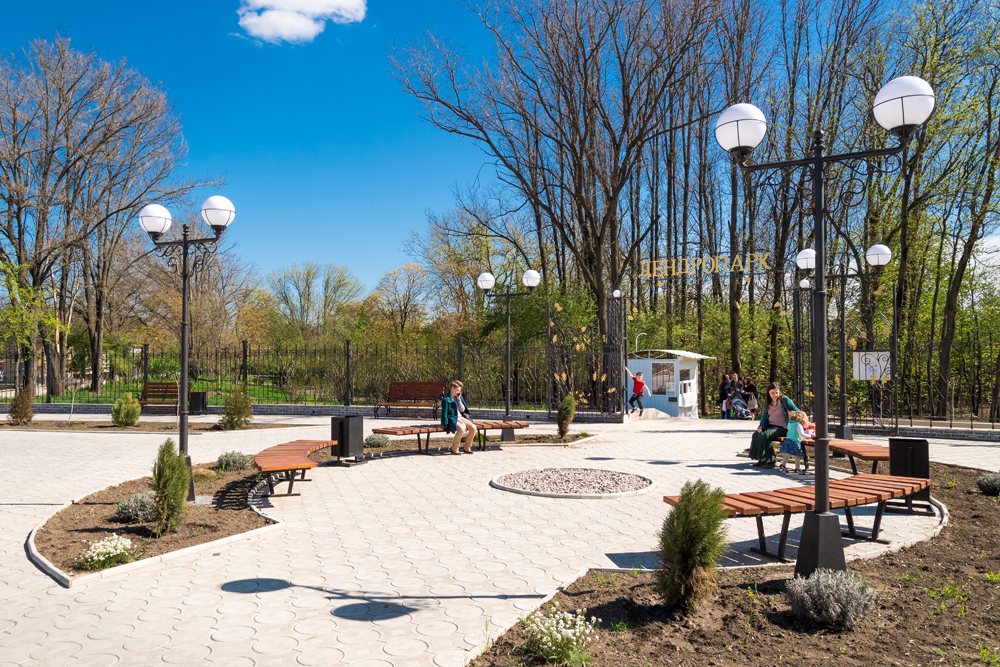
Botanical Garden
Established in 1959 on the initiative of academician P.I. Dvornikov, the Botanical Garden of Tiraspol spans an impressive 20.5 hectares along the eastern edge of the city. The garden has earned its reputation through its remarkable and ever-expanding collections of woody, shrubby, perennial and annual plant species, while also serving a practical purpose in cultivating plants used for beautifying cities and districts throughout Pridnestrovie.
At the very heart of the garden lies its most celebrated feature — a magnificent rose garden boasting more than 200 distinct varieties, drawing visitors who simply wish to wander among the blooms. The garden’s dendrological section, occupying the north-western portion of the grounds, offers equally impressive riches: rare coniferous and deciduous species gathered from different corners of the world create a living catalog of global botanical diversity. Visitors will also find dedicated collections of spice and medicinal plants, alongside species included on endangered lists, reflecting the garden’s role in conservation as well as beauty.
The garden transforms dramatically with the seasons. April brings the spectacular sight of a blooming tulip field, while June introduces a stunning lavender field that has become a favorite spot for photography. In 2018, pomegranate seedlings were planted for the first time, and they have taken remarkably well to the local climate — today, more than 10 thriving bushes call the garden home. Come autumn, visitors can spot the bright, vivid fruits of pomegranate ripening throughout the grounds, adding yet another seasonal highlight to this ever-evolving botanical treasure.
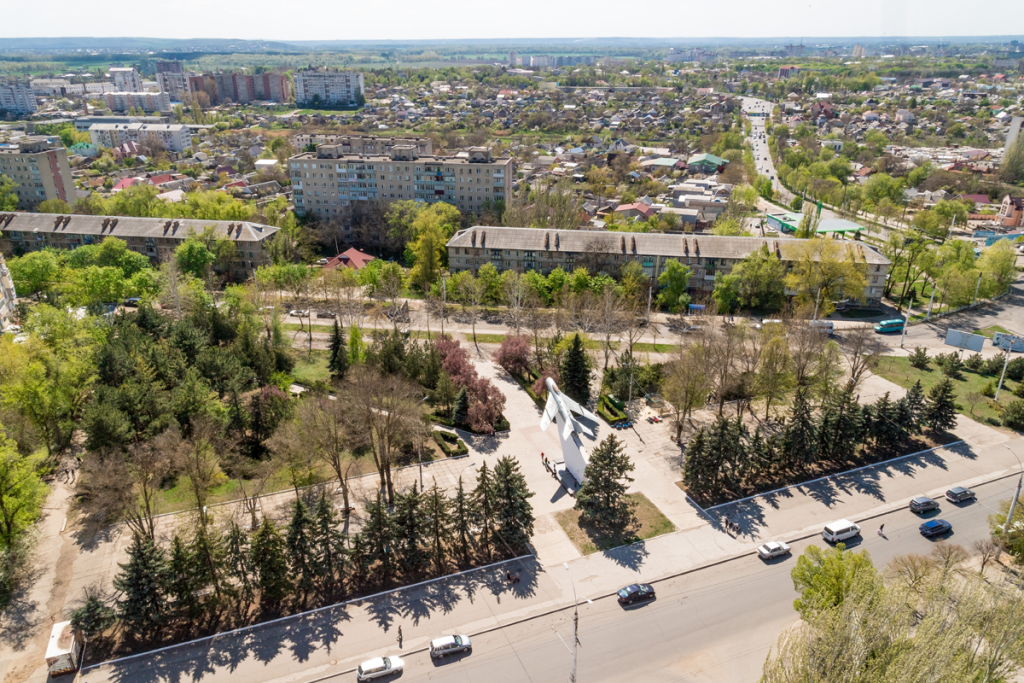
Monument to Aviators
Tucked within a small garden between Kakhovskaya and Yunosti streets stands an unusual and striking construction — a silver MIG-19 fighter jet, mounted on a pedestal and positioned as if soaring upward into the sky. This dramatic monument to aviators was unveiled on May 8, 1975, deliberately timed to coincide with the eve of the 30th anniversary of Victory in the Great Patriotic War.
The monument specifically honors the pilots of the 17th Air Army, who, operating as part of the 3rd Ukrainian Front, played a crucial role in liberating Tiraspol from German-fascist invaders in 1944. At the time of this liberation campaign, the army was commanded by Lieutenant General V.A. Sudets, who would later go on to be honored as a Hero of the Soviet Union and ultimately achieve the rank of Air Marshal. In recognition of his contributions to the city’s liberation, the Executive Committee of the Tiraspol City Council of Deputies awarded Sudets the title of “Honorary Citizen of Tiraspol” in 1964, cementing his connection to the city he helped free decades earlier.

Pobeda (Victory) Park
The original concept for this park is credited to renowned Soviet architect A.V. Shchusev, who visited Tiraspol during the post-war years and envisioned a meaningful green space for the city’s residents. Spanning 15 hectares, the park was established in 1947 on the site of a former fruit and berry garden, which at the time was situated beyond the eastern outskirts of the city. The park received its name to commemorate Victory (“Pobeda”) in the Great Patriotic War, honoring the immense sacrifice and ultimate triumph that defined this period of history.
Over the years, the park gradually expanded to include a fountain, a summer stage, various rides and playgrounds, transforming it into a comprehensive recreational destination. Today, Pobeda Park ranks among the most beloved resting places for residents of the capital, regularly hosting diverse cultural events throughout the year. Visitors can enjoy several cafes scattered throughout the grounds, along with a large observation wheel that offers a genuinely impressive panoramic view of the city from its highest point.
In 1960, a monument honoring G.I. Kotovsky was installed at the center of the park — commemorating this notable Soviet military and political figure who played an active role in the revolutionary movement during the Civil War era. Kotovsky demonstrated remarkable courage on the battlefields of the First World War, later continuing his military service by fighting against Romanian invaders in Bessarabia. In 1920, a cavalry brigade under his command successfully won Tiraspol from the Armed Forces of South Russia, with Kotovsky’s unit earning recognition as one of the finest in the entire Red Army during this period.
Sculptor L.I. Dubinovsky created the monument depicting Kotovsky in military uniform, leaning thoughtfully on his cavalry saber. Interestingly, this monument was not originally created for Tiraspol — it was first installed in Moscow at VDNKh, positioned at the entrance to the Moldavian SSR’s exhibition pavilion, before later being relocated to Tiraspol, where it now stands as a central feature of Pobeda Park, connecting the capital to this significant chapter of revolutionary and military history.

Shevchenko Pridnestrovian State University
Shevchenko Pridnestrovian State University traces its origins back to the oldest higher educational institution operating within the territory of the Republic — the Tiraspol State Pedagogical Institute, founded in 1930. The university’s very first building was constructed according to a design by architect M. Petrov, and this historic structure now houses Building “B” of the modern university campus. Just in front of this building, within a garden adjacent to Teatralnaya Square, stands a granite monument honoring the celebrated Ukrainian poet Taras Shevchenko, whose name was bestowed upon the university to mark the 125th anniversary of the “Great Kobzar’s” birth — a fitting tribute connecting this educational institution to one of Ukraine’s most revered literary figures.
Across the street, another significant building from the 1930s was constructed by Daniil Kovalenko, an honored architect of the RSFSR. This structure originally housed the Communist University, where party cadres received their political education and training. Today, this same building serves as the central administrative headquarters of Pridnestrovian State University, continuing to play a central role in the institution’s operations, albeit with a dramatically different educational mission than its original purpose.
SPSU stands today as the Republic’s primary educational and research center, employing more than a thousand teachers who guide over 11,000 students across more than 140 different specialties. The university maintains approximately 30 research laboratories alongside dozens of sports and creative teams, making it a genuinely comprehensive institution that shapes the intellectual, scientific and cultural life of Pridnestrovie for generations of students.
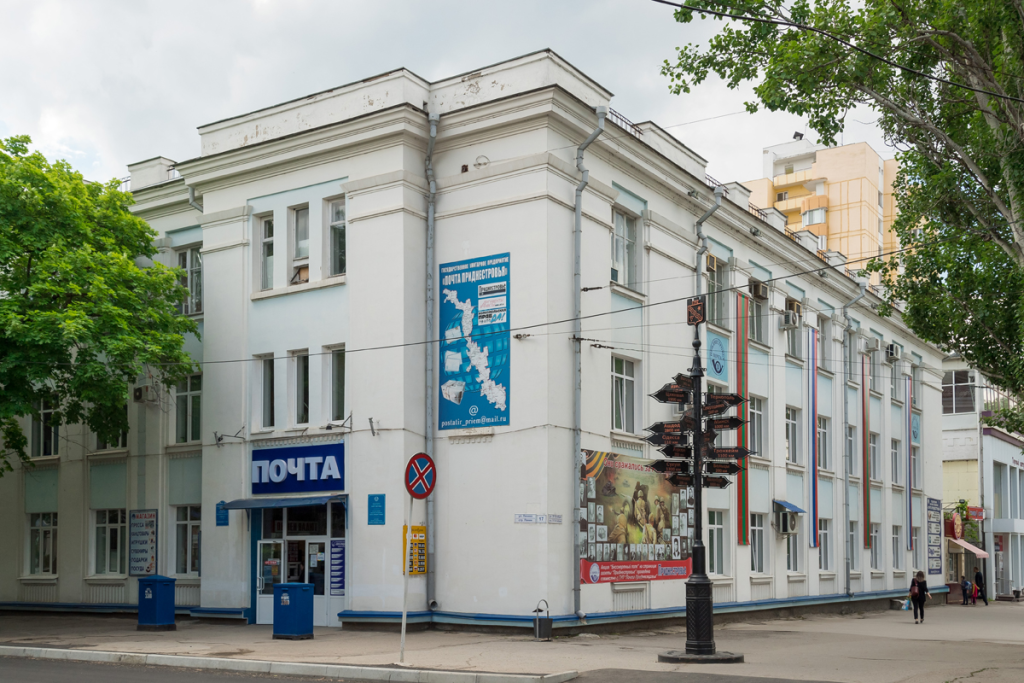
Post of Pridnestrovie
The headquarters of the Post of Pridnestrovie has graced the capital since the early 1960s, though postal services in Tiraspol can trace their history back more than 220 years, reflecting a deep and continuous tradition of communication infrastructure in the city. Previously, the post and telegraph office occupied a beautiful two-story building on what is now 25 Oktyabrya Street — a street that, until 1884, was known as Pochtovaya (Post) Street, named for its role as the postal road connecting Tiraspol and Odessa. Unfortunately, this original historic building has not survived to the present day.
Pridnestrovie’s postal history reached a significant milestone in 1993, with the introduction of the region’s first postage stamp, carrying a face value of 12 rubles. This inaugural stamp featured the coat of arms of the PMR rendered in dark blue against a blue background, marking the beginning of the republic’s own independent postal identity.
To commemorate Tiraspol’s 225th anniversary, a distinctive landmark known as “Kilometre Zero” was unveiled near the central post office — a striking 4.5-meter signpost displaying the names of Tiraspol’s twin cities alongside the precise distance separating them from the Pridnestrovian capital, creating a tangible connection between Tiraspol and its sister cities around the world.
Directly opposite the post office stands a three-story building constructed in 1933 in the Soviet Neoclassicism style, representing an excellent example of the architectural development that characterized central Tiraspol during the pre-war years. Interestingly, the building’s now-famous belvedere only crowned the structure after the Great Patriotic War — it replaced an earlier female statue that had occupied this position but was severely damaged during the retreat of German fascist troops, adding another layer of wartime history to this architecturally significant corner of the city.
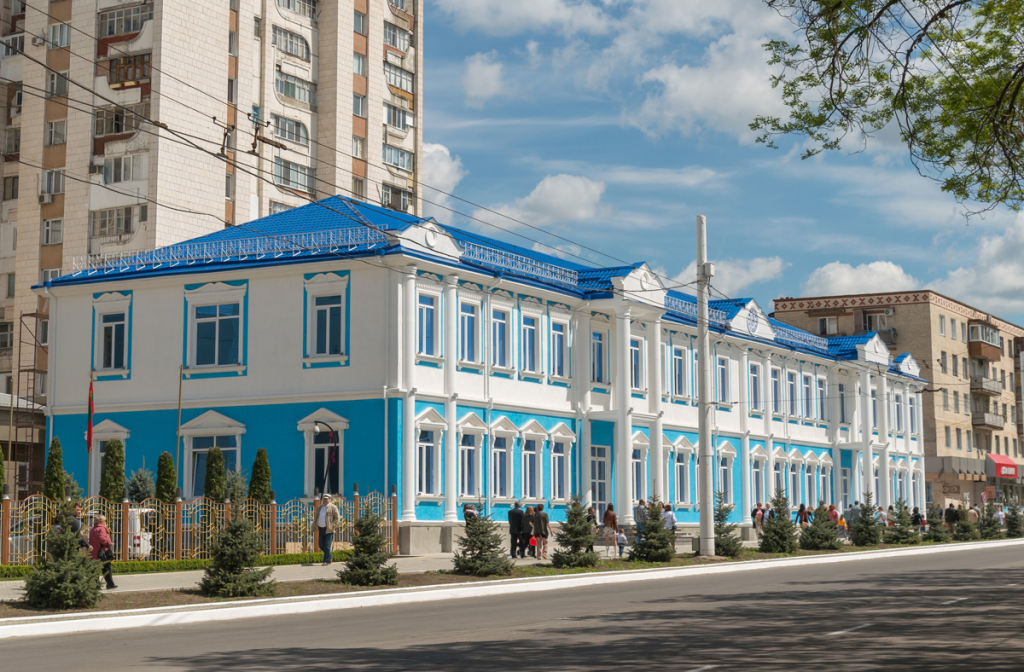
Building on Pokrovskaya Street (Medical Center "TiraMed")
This historic building has long served as a local landmark, playing a significant role throughout Tiraspol’s development across more than a century. Constructed on Pokrovskaya Street during the last quarter of the 19th century, the building was originally built by merchants to serve administrative needs, eventually becoming home to a commercial club where Tiraspol’s merchant community could gather. The growing commercial importance of Tiraspol throughout the 19th century contributed significantly to the flourishing of this merchant class, which was itself subdivided into different guilds based on available capital.
Members of the merchant class required a dedicated space for both business meetings and entertainment, and this building filled that role admirably. Visiting traders could stay in rooms with meals provided, while touring artists performed in the building’s halls for entertainment. In the evenings, a restaurant operated within the building, where merchants played billiards, discussed business matters, concluded important deals and held their annual reporting meetings. The commercial meeting hall also hosted New Year’s fancy-dress evenings for children, organized according to traditional biblical programming. Beyond purely commercial functions, the merchant class increasingly embraced patronage and charity during this period, becoming important supporters of Russian culture, science, technology and publishing.
The building’s purpose shifted with changing political times: in the 1920s, it housed a workers’ club featuring numerous circles and clubs, including a notable drama club. In the 1930s, architect M.E. Petrov oversaw a significant reconstruction project, adding a second floor to the building and opening a working clinic within its walls.
During the difficult years of occupation (1941-1944), while Nazi forces seized many of the city’s finest buildings for their own purposes, this particular polyclinic managed to retain its original medical functions, even though the chief physician during this period was a protégé installed by the occupation authorities. Remarkably, the head doctor’s cleaner, a woman named Kolesnichenko from Tiraspol, had daughters who were schoolgirls and secretly became members of the Tiraspol pioneer underground — a patriotic resistance group organized by Maria Skopenko, a Komsomol member from the city of Voznesensk. In the evenings, while helping their mother with cleaning duties, these brave young girls would close the doctor’s office from the inside and secretly listen to broadcasts from the Soviet Information Bureau using an existing radio. They carefully transcribed what they heard and pasted leaflets in crowded public locations, marking them with a red star in one corner and a red flag in another, ensuring people could recognize these messages of resistance from a distance.
In 1947, the building transitioned to house the city health department, and beginning in 1952, it operated as a full polyclinic. Today, continuing this long medical tradition, the building serves as the modern TiraMed Medical Center, carrying forward more than a century of service to the health needs of Tiraspol’s residents.

Suvorov Square
Suvorov Square rightfully claims its place as the heart of both Tiraspol and the entire Pridnestrovian republic. The square is surrounded by an impressive cluster of significant landmarks — the monument to A.V. Suvorov himself, De Wollant Square, the riverside embankment, the Memorial of Glory, the Palace of Children and Youth Creativity, a cinema and the building of the Supreme Council of the PMR, all converging to make this one of the most important civic spaces in the entire country.
During the Soviet era, the square bore a different name — Stalin’s Constitution Square — and it wasn’t until the 1970s, following large-scale restructuring of the town center, that the square took on the appearance familiar to visitors today. Suvorov Square continues to play a central ceremonial role in national life, hosting military parades on the country’s most important holidays, including Victory Day commemorating the Great Patriotic War and Republic Day itself.
Looking ahead, the entire area surrounding the square is set for further transformation, with plans to develop the surrounding space into Catherine Park — a project whose construction was slated for completion in 2020, promising to add even more green space and grandeur to this already iconic central gathering place.
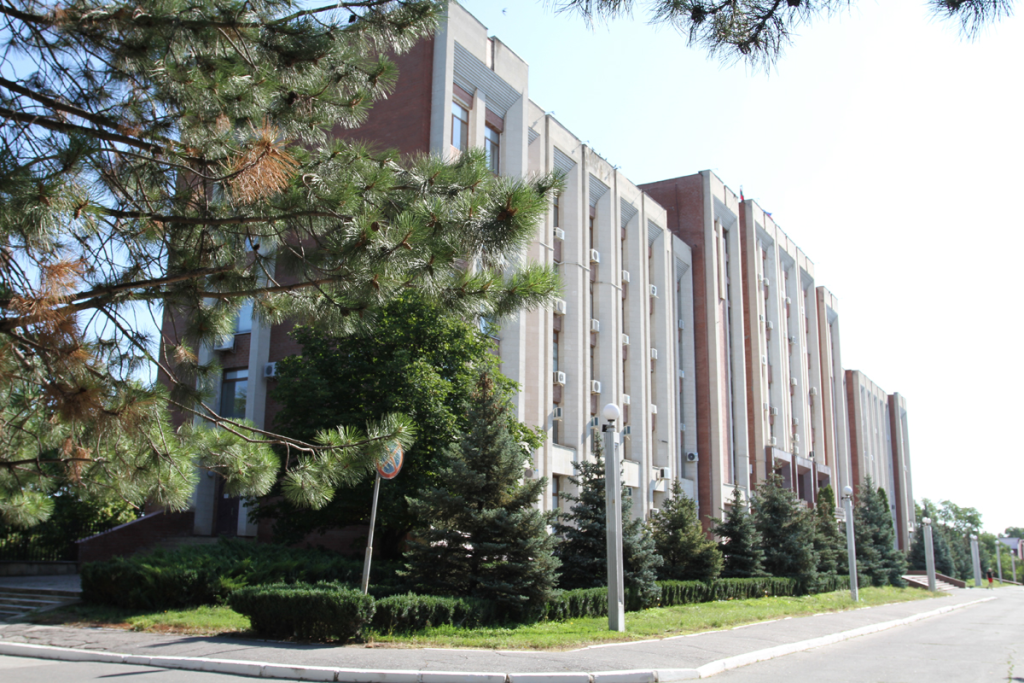
Building of the Supreme Council and Government of the Pridnestrovian Moldavian Republic
This impressive building was constructed in 1983, originally erected to house the Tiraspol City Committee of the Communist Party of the Soviet Union. Long marble steps lead visitors up to this massive structure, positioned prominently in the historical center of Tiraspol, with the building’s architecture clearly reflecting the distinctive design trends of the late Soviet period.
Following the collapse of the Soviet Union, the building briefly housed a branch of the state university before taking on its current significant role: since 1991, it has served as home to the Supreme Council, the Parliament of the Pridnestrovian Moldavian Republic. For an extended period, the building also functioned as a presidential office, and since 2012, it has additionally housed the Government of the Republic, making it the genuine seat of political power in Pridnestrovie.
The Building of the Supreme Council and Government has come to be regarded as a symbol of the Pridnestrovian Moldavian Republic itself, ranking among the most recognizable landmarks throughout the entire region. Tourists frequently view the building as a quintessential attribute of Pridnestrovie’s Soviet past, and the Lenin monument standing before it has become an essential photo opportunity for nearly every visitor.
This monument to Vladimir Lenin, mounted on a tall pedestal, was erected in 1987 to mark the 70th anniversary of the October Revolution, positioned directly in front of what was then the City Committee of the CPSU. The monument’s design drew inspiration from a famous nineteen-meter monument to the leader of the world proletariat that once stood in Berlin, originally created in 1970 by the celebrated Soviet sculptor Nikolai Tomsky. Seventeen years later, working within Tomsky’s own studio, his student V.S. Klimachev created this new statue, which continues to stand proudly in front of the Supreme Council of Pridnestrovie to this day. In an interesting historical footnote, just four years after the Tiraspol monument’s creation, its Berlin counterpart — the original inspiration for this design — was dismantled, leaving the Tiraspol Lenin as something of an enduring legacy of a monument that no longer exists in its city of origin.