
Socialist Realism in Bender
Soviet Monumental Art Route: Bender
Step into a living gallery of Soviet artistic heritage on this extraordinary urban route through Bender — a fascinating 31 km journey across 14 remarkable sites of monumental art that have survived the test of time. With mosaics, bas-reliefs, frescoes and murals adorning factories, cultural centers and street corners alike, this route is a must for anyone captivated by the unique aesthetic of the Soviet era. Set aside a generous 4–5 hours to take in every detail of this remarkable open-air museum.
Soviet architecture holds a special allure for visitors to Pridnestrovie, and nowhere is this more evident than in Bender. The city’s walls, facades and public spaces tell the story of an era through its art — heroes of labor, soldier-liberators, cosmonauts, athletes, pioneers and collective farmers, all rendered in vivid mosaics deeply rooted in Moldovan culture and everyday life.
The route opens at the House of Culture named after P. Tkachenko (32 Lenin Str., Bender) — one of the finest examples of Soviet monumental art in the city, its facade a showcase of the era’s bold artistic ambitions.
Just 1.3 km away, the Monumental Mosaic Panel on the Fat-Frumos Restaurant (52 Kirova Str., Bender) presents one of the most striking and well-preserved decorative works on the route — a vivid tableau of Soviet-era imagery that stops passersby in their tracks.
After 1.7 km, the Monument to the Fighters for Soviet Power in Oktyabrsky Park adds a sculptural dimension to the journey — a powerful tribute to those who fought for the establishment of Soviet authority in the region.
Continuing 830 meters, the Former Bus Station (1 Sovetskaya Str., Bender — now Piazza Italia shop) offers a fascinating example of adaptive reuse, where Soviet decorative art survives within a completely transformed commercial space.
Just 6.1 km further, the Bus Stop “Silk Factory” (Industrial Str., Bender) demonstrates how Soviet artists brought monumental art even to the most everyday urban fixtures — a beautifully decorated bus stop that elevates a mundane commute into a cultural experience.
Only 110 meters away, the Silk Factory Checkpoint (12 Industrial Str., Bender) showcases how industrial enterprises of the Soviet era used art to celebrate the dignity and heroism of labor — a theme that runs like a golden thread through this entire route.
After 690 meters, the House of Culture “Shelkovik” (2a 40 Let VLKSM Str., Bender) stands as one of the route’s most complete examples of Soviet cultural architecture, its decorative program a rich visual celebration of community, industry and progress.
Continuing 1.9 km, the Moldavkabel Plant Checkpoint (10 Industrialnaya Str., Bender) presents another remarkable industrial mosaic — a testament to the pride Soviet enterprises took in decorating even their most functional spaces with monumental art.
Just 4.9 km further, the Bender Agrarian and Economic College (20 Industrial Str., Giska village) carries the artistic tradition into the realm of education, its decorative elements reflecting the Soviet ideal of knowledge, progress and the cultivation of the land.
A short distance away, the Bus Stop “Planning and Economic State Farm-Technical School” in Giska village continues the democratic spirit of Soviet public art — beauty brought to the streets for everyone.
After 4.2 km, the striking Panel “Science — the Productive Force of the Era” in Giska village makes one of the route’s boldest artistic statements — a sweeping celebration of Soviet scientific achievement rendered in vivid monumental form.
Returning toward the city center, the Bas-Relief on the Northern End of the River Station (18 Pavel Tkachenko Str., Bender) offers a dramatic riverside setting for one of the route’s most elegant decorative works — history and art meeting at the water’s edge.
Just 690 meters away, the Decorative Bas-Relief Above the Entrance to the Registry Office (29 Gagarin Str., Bender) adds an intimate and personal dimension to the route — art marking the threshold of life’s most significant moments.
The route concludes 2.7 km further at the Bas-Relief on the Facade of the Varnitsa Factory (71 Dzerzhinsky Str., Bender) — a fitting industrial finale that brings the journey full circle, closing with the same celebration of labor and community that defines Socialist Realism at its finest.

House of Culture named after P. Tkachenko
The House of Culture named after P. Tkachenko holds a special place in architectural history, having become one of the first buildings in Moldova where a comprehensive architectural and artistic design approach was fully realized. Flanking the central entrance, the building features striking statues on either side: to the left, a young man in coveralls holds a coil of wire alongside a girl in national costume holding a piece of fabric — together representing the products of Bender’s leading enterprises. To the right, another young man plays the fluer, a traditional Moldovan folk instrument, while a girl beside him holds a grapevine, symbolizing the region’s agricultural heritage.
The story behind these mosaics is genuinely fascinating. Construction of the House of Culture took place during the height of the Soviet campaign against architectural “excesses,” initiated by Nikita Khrushchev. In an effort to reduce construction costs, planners decided to eliminate the decorative columns originally intended to adorn the building, opting instead to cover the now-bare wall surfaces with mosaic artwork. Ironically, the final cost of creating these elaborate mosaics ended up exceeding what the columns themselves would have cost — a curious twist in the building’s economic history.
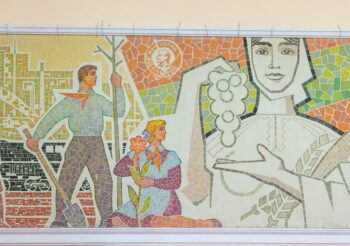
The crowning artistic achievement, however, awaits visitors in the lobby of the House of Culture: a magnificent mosaic-style panel titled “Workers of the City of Bender.” At the center of this composition, set against the backdrop of the State Flag of the Moldavian SSR adorned with the Order of Lenin, a young woman is depicted holding the gifts of Moldovan land, symbolizing the prosperity of the republic. Citizens of the city flank her on either side, united in a shared labor impulse dedicated to the prosperity of their homeland. On the opposite wall, four additional mosaic scenes complement the main panel, depicting pivotal moments from the city’s and republic’s history: peasant uprisings against Turkish rule, Russian military campaigns against Ottoman fortresses in Moldova, the revolutionary events of 1917, and the liberation of Moldova from German-Romanian invaders in 1944 — together forming a sweeping visual narrative of struggle, resilience and ultimate triumph.
Monumental Mosaic Panel on Fat-Frumos Restaurant
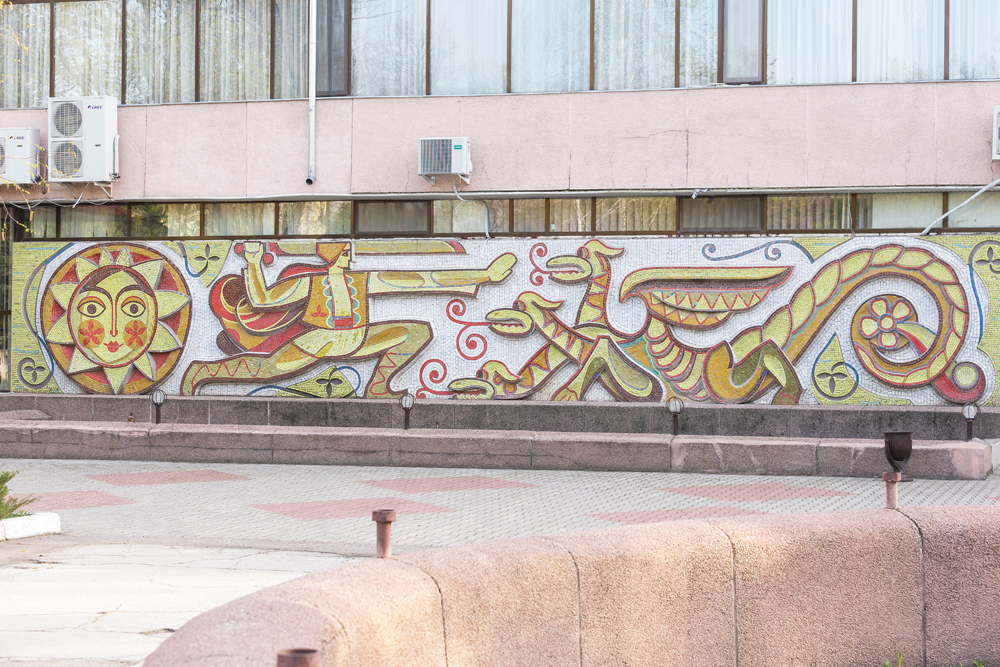
This striking monumental mosaic panel brings a beloved piece of Moldovan folklore vividly to life on the facade of the Fat-Frumos Restaurant in Bendery. The artwork depicts the legendary hero Fat-Frumos locked in fierce battle with an evil dragon, in a dramatic moment that captures the climax of this cherished folk tale — Fat-Frumos liberating the sun itself from the dragon’s dark dungeon, releasing it back into the firmament where it belongs.
The mosaic stands as a vibrant example of Soviet-era monumental art drawing directly from local cultural mythology, transforming a simple restaurant facade into a colorful visual narrative that connects passersby to the rich storytelling traditions of Moldovan folklore.
Monument to the Fighters for Soviet Power
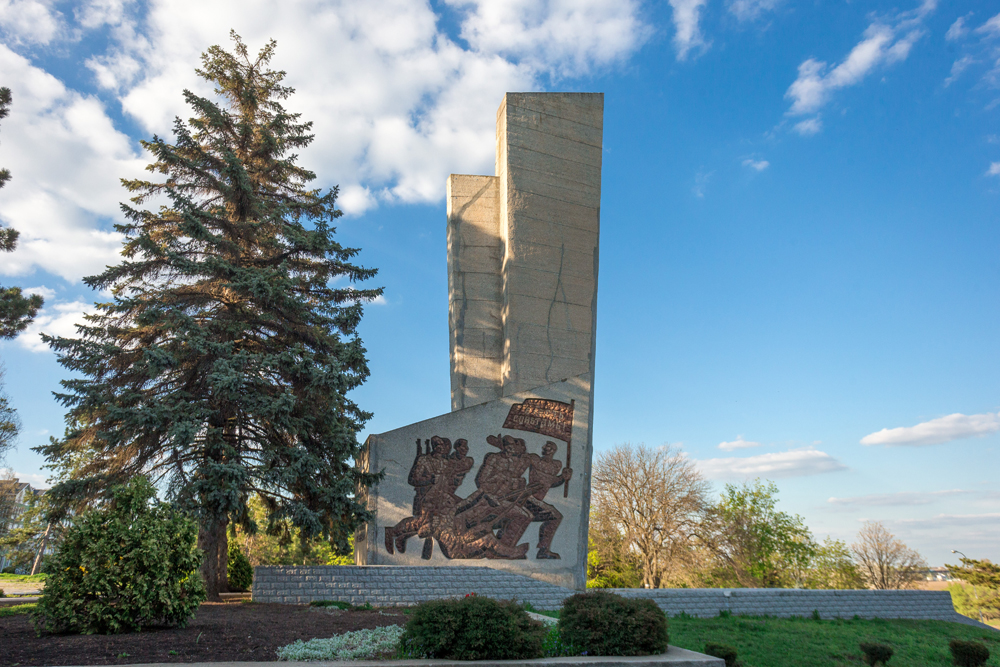
Among the works attributed to artist M.A. Bury are two remarkable mosaics adorning the Monument to the Fighters for Soviet Power, erected in 1969 in Bendery’s Oktyabrsky Park to commemorate the 50th anniversary of the Bendery armed insurrection. Together, these mosaics tell a complete narrative arc: one panel symbolizes the beginning of the uprising against Romanian occupiers, while the second captures its sorrowful conclusion, creating a powerful visual story of struggle and sacrifice.
What makes these particular mosaics unique within Bendery’s broader collection of monumental art is the material used — Zhytomyr granite in striking red shades, employed exclusively in this composition. This distinctive stone ennobles the overall color scheme of the monument, creating a cohesive painterly whole that remains strikingly legible even when viewed from considerable distances, allowing the monument’s emotional impact to reach visitors throughout the surrounding park.

Former Bus Station
The mosaics decorating the former waiting room of the Bendery bus station rank among the most vivid and artistically valuable examples of Soviet monumental art in the entire city. Created in 1966 by renowned Moldavian Soviet artists V.A. Obukh and M.A. Bureya, these works demonstrate the remarkable creative ambition of their era.
The end walls showcase two complementary compositions — “Old Bendery” on the right and “New Bendery” on the left — while the mezzanine floor features “Red Square,” positioned along the central axis of the main entrance, creating a thoughtfully orchestrated visual journey for anyone passing through the space.
Within these mosaics, historical monuments and architectural landmarks of the city emerge in clearly recognizable detail. The “Old Bendery” composition features the memorial of glory to the 55th Podolsk Infantry Regiment, the Bendery Fortress, the Transfiguration Cathedral and a traditional challah loaf, while “New Bendery” depicts the monument to Pavel Tkachenko alongside the House of Culture named in his honor, the M. Gorky cinema, the railway station and other notable city landmarks — together creating a visual dialogue between the city’s past and its Soviet-era present.
The creation of these mosaics represented a significant contribution to the broader development of Moldovan monumental art. The artists successfully tackled a genuinely challenging artistic problem: unifying three independent compositions into a single cohesive pictorial ensemble. The mosaics’ color palette is distinguished by a harmonious interplay of red, ocher-yellow and grayish-blue tones, lending the entire work a distinctive and immediately recognizable visual identity.

Bus Stop "Silk Factory"
Every resident and visitor arriving in the silk workers’ village by public transportation would have been greeted by this impressive stop pavilion, its interior wall decorated along its full length with a striking mosaic resembling silk fabric, complete with an original and graceful decorative pattern. Through its sheer scale and artistic ambition, the mosaic made an immediate statement: travelers had arrived at the territory of a genuine all-Union industrial giant — the Bendery Labor Silk Factory, an enterprise so distinguished that it was awarded the Order of the Red Banner and named in honor of V.I. Lenin himself.
This thoughtfully designed bus stop exemplifies how Soviet-era public infrastructure often served as more than mere functional necessity, transforming an everyday waiting area into a genuine work of art that proudly announced the industrial significance of the community it served.
Silk Factory — Checkpoint
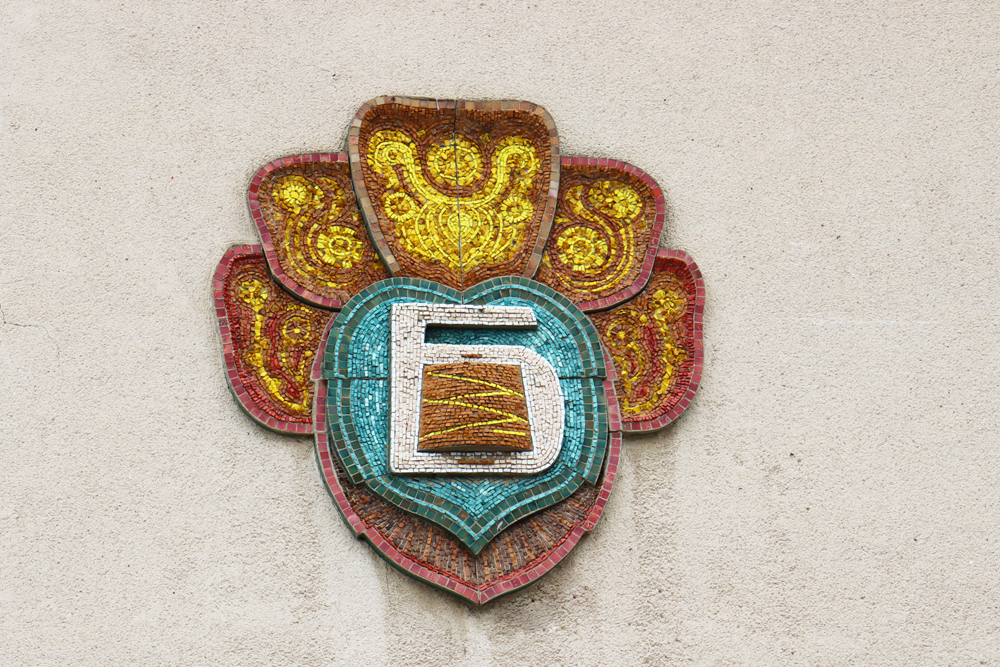
The checkpoint at the entrance to the Bendery Silk Factory features another captivating mosaic, and while smaller in scale than its counterpart at the nearby bus stop, it loses none of its visual intrigue. The composition centers on a striking capital letter “B” — the first letter in the city’s name — cleverly designed so that its lower portion resembles a bobbin wound with silk thread, a clever nod to the factory’s primary industry.
The letter itself rests upon a base shaped like a mulberry leaf, its heart-like silhouette crowned with elegant decorative patterns. The design invites multiple interpretations: some viewers see echoes of a traditional Russian kokoshnik headdress, others perceive the flowing tail of the mythical Firebird, while still others suggest the artist simply intended to depict a mulberry tree — fitting given the tree’s essential role in silk production. Whatever interpretation resonates most, this small but artistically rich mosaic adds a layer of visual storytelling to the industrial checkpoint, transforming a purely functional structure into a piece of genuine creative expression.

House of Culture "Shelkovik"
For more than half a century, the House of Culture “Shelkovik” — now operating as a cultural and leisure center — has stood at the heart of cultural life in this district of Bendery. Built in 1967, the building features two beautiful mosaics depicting girls dancing in traditional national costumes, arranged symmetrically with three figures positioned to the left of the central entrance and three more to the right. Adding further visual richness, the building’s perimeter is adorned with a mosaic frieze showcasing alternating floral patterns that wrap continuously around the structure.
This particular example perfectly illustrates a broader principle behind much of Soviet monumental art: the primary purpose of these mosaics was to give a distinctive identity to what was, architecturally speaking, a fairly typical building — one of many similar structures constructed throughout Soviet Moldova during this period. Through careful artistic decoration, “Shelkovik” transcended its standard architectural form, becoming a genuinely memorable and beloved cultural landmark in its own right.

Moldavkabel Plant — Checkpoint
One of the largest mosaics by area found anywhere in the city decorates the facade of the Moldavkabel plant, once the recognized leader of the cable industry throughout Soviet Moldova. Created in the 1980s, this expansive artwork was specifically designed to motivate factory employees toward professional excellence, transforming the entrance to their workplace into an inspiring visual statement.
The mosaic’s composition cleverly incorporates repeated, intertwining turns of wire — a direct nod to the factory’s core product — which cross and curve to form four distinct medallions. Reading from left to right, these medallions depict scenes celebrating the happy working life of Bendery’s cable industry employees: Design Bureau staff engaged in developing innovative new products; factory workers actively engaged in the production workshop; a joyful family of cable workers enjoying domestic happiness; and finally, factory workers proudly displaying finished products alongside the coveted USSR State Quality Mark, an award their products had earned through excellence.
Together, these four scenes create a comprehensive visual narrative celebrating both the technical achievement and human dimension of industrial work — precisely the kind of inspirational message Soviet planners hoped such monumental art would instill in the workforce passing beneath it each day.
Bendery Agrarian and Economic College
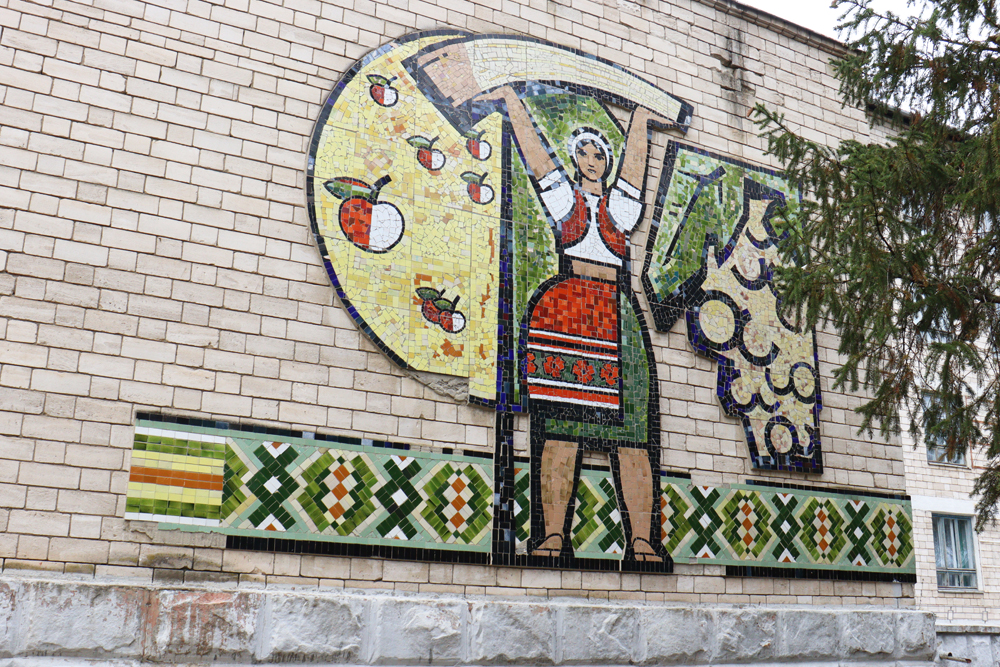
This educational building represents another example of standard Soviet-era architectural design, where mosaics were deployed to bring distinctive character and visual identity to an otherwise typical structure. Opened in 1966 in the village of Giska, the building originally housed the Moldavian Farm-Technical School for Planning and Economics — an institution distinguished enough to be awarded the Order “Sign of Honor” — and today continues its educational mission as the Bendery Agrarian and Economic College.
The mosaics adorning this building were specifically designed to communicate the institution’s core purpose: training skilled professional personnel for the republic’s agricultural sector. To the right of the central entrance, one composition depicts a young man and woman dressed in traditional national costumes, set against the backdrop of a rising sun. Together they hold a book and a bowl of fire — powerful symbols representing the transformative power of knowledge and education. The complementary mosaic on the opposite side portrays a state farm worker holding a sheaf of wheat triumphantly in raised arms, surrounded by the abundant gifts of Moldovan land — apples and grapes that speak to the agricultural richness the institution’s graduates would go on to cultivate and manage. Both compositions are elegantly framed by horizontal ribbons featuring traditional national ornamental patterns, tying the entire artistic ensemble together with a cohesive decorative thread.

Bus Stop "Planning and Economic State Farm-Technical School" (Giska Village)
Just a short distance from the technical school, another distinctive “mosaic” bus stop awaits discovery in Giska village. This pavilion stands out through its complete decorative treatment, with every vertical surface adorned in mosaic artwork depicting scenic landscapes. The thoughtful design transforms what would otherwise be a purely functional waiting area into a small gallery of artistic expression, continuing the broader tradition found throughout this district of using everyday public infrastructure as a canvas for monumental Soviet-era art.
Panel "Science — The Productive Force of the Era" (Giska Village)
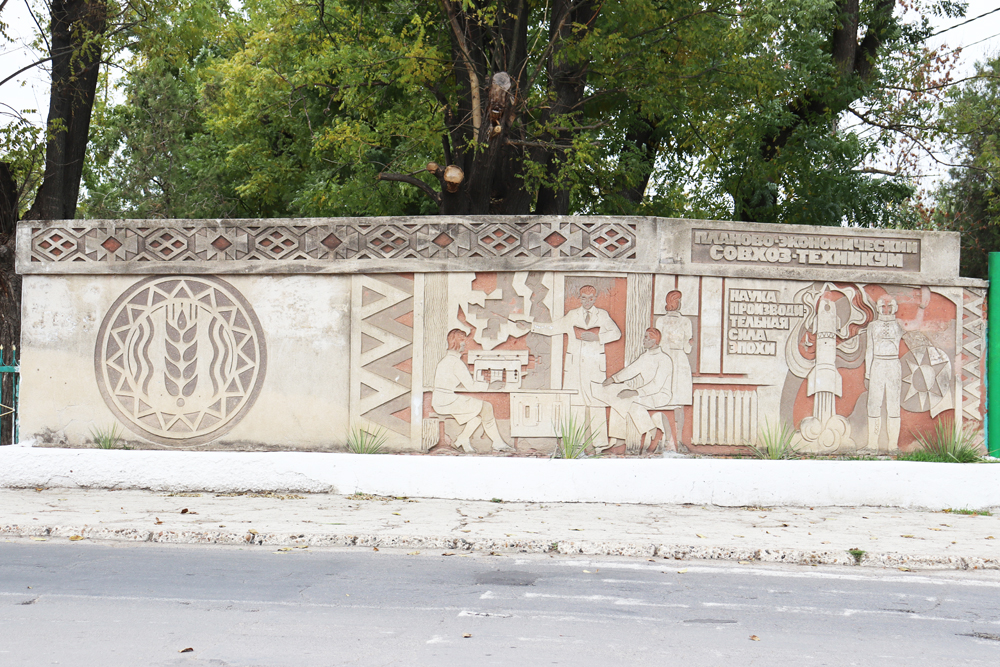
A straight alley leads from the bus stop toward the entrance of the educational building, and along this path visitors encounter two striking panels crafted using the technique of decorative plaster. Much like the mosaics decorating the facade of the technical school itself, these panels were created to visually express the inseparable connection between education, scientific progress and agricultural success — themes central to the Soviet ideological vision of the era.
The panel on the left illustrates the educational process itself, depicting how dedication to learning leads ultimately to scientific achievement — symbolized here through the dramatic image of a rocket launching skyward, accompanied by an astronaut warmly welcoming the viewer into this vision of progress. The complementary panel on the right turns its attention to the grateful and productive work of agricultural laborers, completing the visual argument that education, science and farming all work together in service of the republic’s prosperity.
Bas-Relief on the Northern End of the River Station
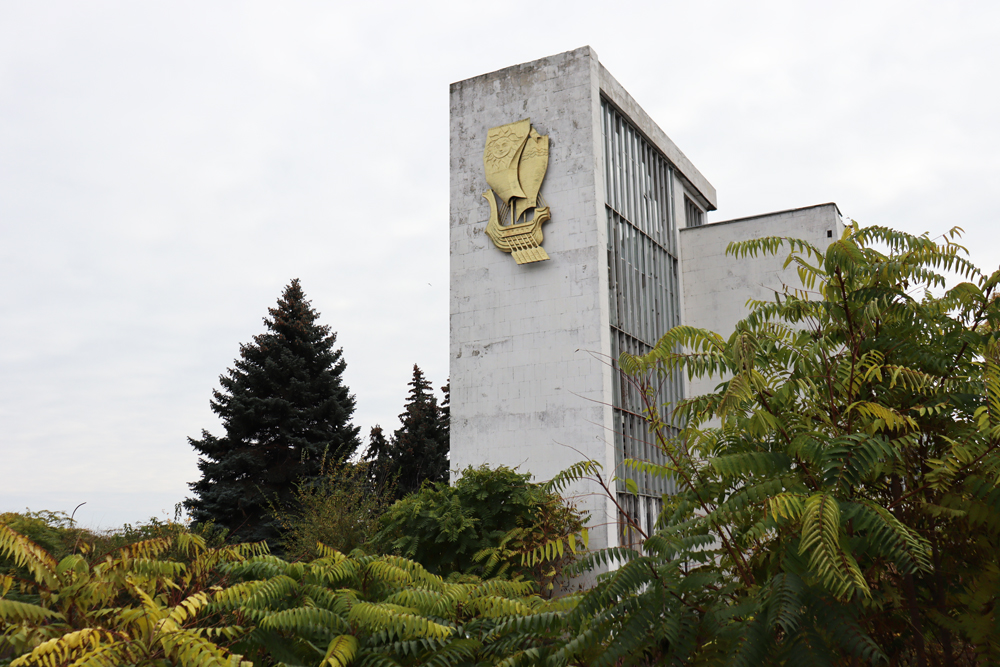
On the northern end of Bendery’s river station building, a striking bas-relief adds artistic depth to this riverside architectural landmark. Positioned along the Dniester waterfront, the sculptural relief contributes to the broader tradition of Soviet-era monumental art found throughout Bendery, transforming a functional river transport facility into a site of genuine visual interest. Set against the backdrop of the flowing Dniester, this bas-relief offers visitors a memorable artistic encounter at one of the city’s most scenic riverside locations.
Decorative Bas-Relief Above the Entrance to the Registry Office
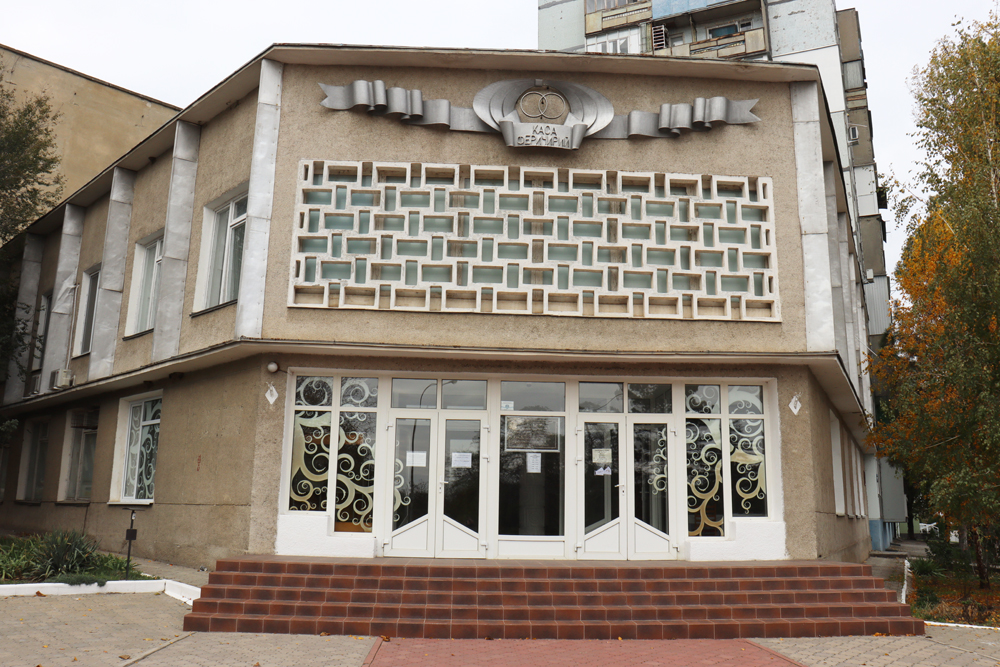
Crowning the entrance to Bendery’s registry office, this decorative bas-relief adds a touch of artistic dignity to one of the city’s most significant civic buildings — the place where countless residents have come to mark life’s most important milestones, from marriages to the official registration of births. The relief continues the city’s rich tradition of incorporating monumental art into everyday public buildings, ensuring that even administrative spaces carry an aesthetic and symbolic weight befitting the personal significance of the moments they host within.

Bas-Relief on the Facade of the Varnitsa Factory
The facade of the Varnitsa Factory in Bendery features a notable bas-relief, continuing the city’s distinguished tradition of incorporating monumental Soviet-era art directly into its industrial architecture. This sculptural relief transforms what might otherwise be a purely functional factory exterior into a piece of public art, reflecting the broader Soviet ideological commitment to celebrating industrial labor through visual storytelling on the very buildings where that work took place. As with the city’s other industrial mosaics and bas-reliefs, this artwork stands as a lasting visual record of Bendery’s manufacturing heritage and the era that shaped it.