 Skip to content

Transnistria’s flag is the only official state flag in Europe that still carries the hammer and sickle. Here’s where that symbolism comes from and why it matters for understanding the region.
The flag. A red-and-green banner with a hammer, sickle and five-pointed star in the upper corner — an almost exact copy of the Moldavian SSR flag used in Soviet times. When Transnistria declared its own statehood separate from Moldova in 1990, the new authorities deliberately kept the Soviet symbolism as a mark of continuity and protest against Moldova’s break with its Soviet past. Today the flag flies on government buildings, squares and border posts — and remains, arguably, the region’s most photographed symbol.
The coat of arms. The PMR state emblem also keeps the Soviet aesthetic: a wheat sheaf wrapped in a wreath, with a hammer and sickle at the center and a rising sun behind it — a composition instantly recognizable to anyone who grew up with Soviet heraldry. It appears on official documents, government building facades and souvenir merchandise, from pins to magnets.
Why it isn’t a museum piece. Unlike most post-Soviet countries, where Soviet symbolism became a historical artifact or the subject of decommunization debates, in Transnistria it remains an active state emblem — used in real state ceremonies, on official documents, and in the everyday life of the city.
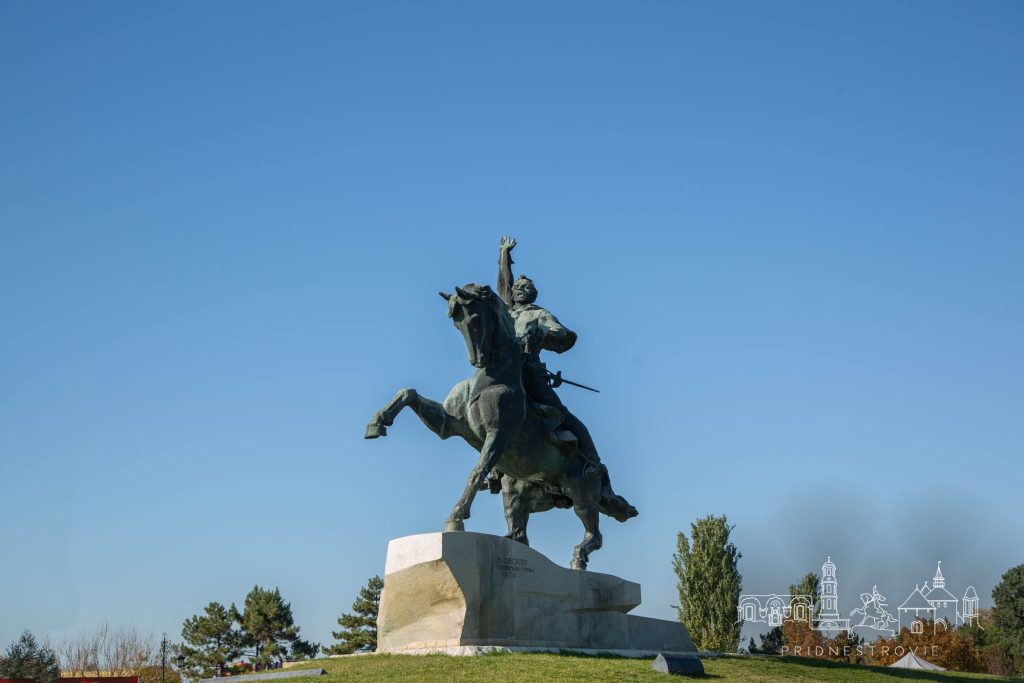
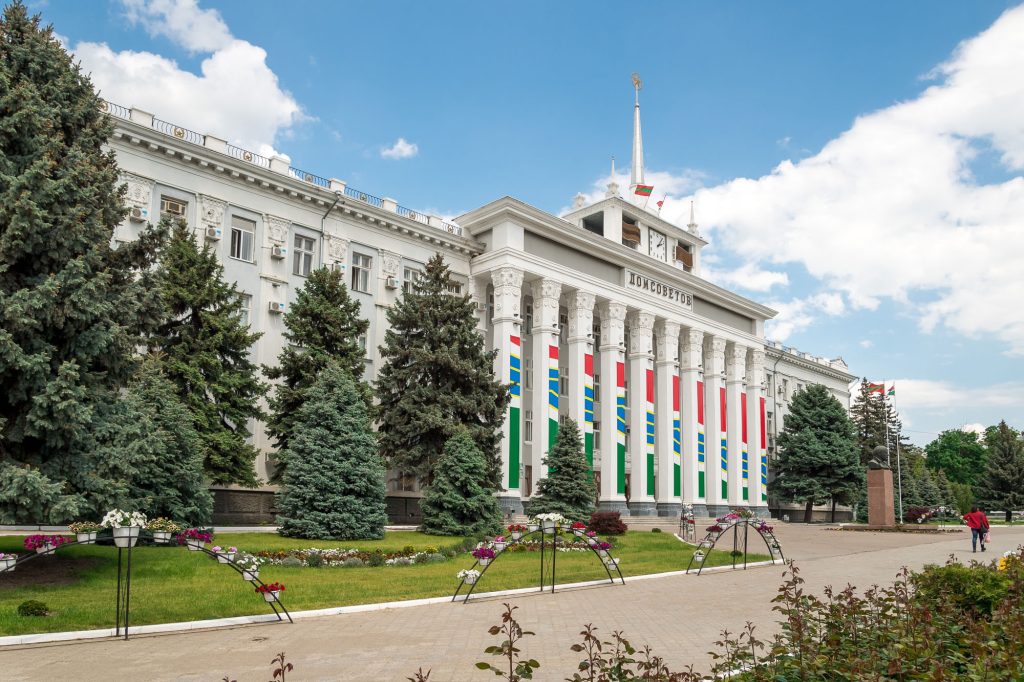
Where to see it in person. The most striking spot is the facade of the House of Soviets in Tiraspol, where vertical flag stripes are literally built into the building’s architecture between the columns. Flags stand on Suvorov Square by the general’s monument, at the PMR Supreme Council building, and on most government buildings downtown. In Bendery, the flag and coat of arms appear at war memorials and on the Triumphal Arch.
What it means for a tourist. For most visitors, the hammer-and-sickle flag becomes one of the trip’s defining shots — visual proof that the region exists in its own reality, separate from the rest of the world. Souvenir versions of the flag and emblem (pins, magnets, stickers) are sold in shops near the main sights.
Moldova’s position. Official Chisinau doesn’t recognize the PMR flag and coat of arms as the state symbolism of a separate country, treating them as attributes of an unrecognized administration on its own territory. This creates no practical problems for tourists — the symbolism is freely photographed and bought as souvenirs on both the Moldovan and Transnistrian sides — but it’s worth understanding the context to read the political sensitivity of the topic correctly in conversation with locals on either side of the border.
The anthem and other symbols. Alongside the flag and coat of arms, the PMR has its own national anthem — “We Sing the Praises of Transnistria” — performed at official ceremonies. Together with the flag and emblem, it forms a complete set of state symbolism that Transnistria maintains and promotes as markers of independence, despite its unrecognized international status.
A brief history. The current versions of the flag and coat of arms were officially adopted in the early 2000s, but visually they’ve barely changed since the PMR was proclaimed in 1990 — making them a rare example of state symbolism frozen in time for several decades.
Also read: Soviet Heritage Tour · An Unrecognized State: What It Means for Tourists · Tiraspol Tour